
Sex, Lies, and Athletic Tape

[Deadspin]

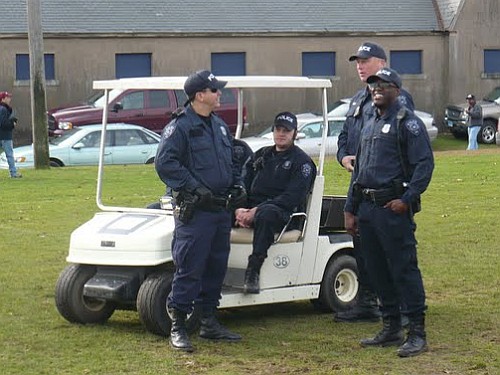
Over at Deadspin, I’ve got a dispatch from this year’s Harvard-Yale game. It’s the 126th time the two have met, and, in both pretension and pageantry, it lives up to your expectations. One of my favorite details from this story was the dust-up over an (allegedly) politically incorrect T-shirt created by Yale students. The administration ended up pushing this anodyne design on the students—but not on too many, judging from the small number I saw at the tailgate.

I’ll include some more photos at the end of this post, but, first, here are a few things I couldn’t fit in. (I should also mention the many helpful books on Ivy League sports—and the fact that, with only two days to turn this story around, I had to skim most of them for the football sections. If the Matt Maloney era at Penn taught us anything, though, it’s that Ivy football is not alone.)

  • Speaking of books: near the end of my story, I mention The Only Game That Matters, a humbly titled history of Harvard-Yale football. Even with its hyper-literate potential audience, this book sold only 3,200 copies (Nielsen Book Scan) and is now out of print—another example of the Harvard-Yale rivalry producing more hype than results. I will point out that, in my copy, checked out from Yale’s Sterling Memorial Library, someone had enthusiastically underlined and starred a passage about how Harvard and Yale’s history predates the United States’. Another passage getting the underline-star treatment? “Beating Harvard was, is, and always will be the yardstick by which joy is measured in New Haven.” This, of course, is complete baloney.
  • One person I talked to while working on the story was Jim Fuller, who covers the Yale football beat for the New Haven Register (and runs a nice blog on the same subject). In 2009, the Ivy League replaced its annual media day with a conference call, and JimĀ argued that this decision will further diminish the League’s relevance. Last year, when a victory over Yale would have given Brown a share of the Ivy title, the Bears’ coach didn’t even come out for interviews because no local media showed up. One other metamedia note: I found it fascinating how many of these odes to the Ivy League mentioned the success former players were having on Wall Street. We’ll have to see how the post-populist coverage of The Game evolves.
  • Let me also draw your attention to “Yale and Athletics” [.pdf], a 1980 address delivered by Yale president A. Bartlett Giamatti. Giamatti—professor of English, commissioner of baseball, and father of Paul—offers a knee-buckling display of erudition. Citing everything from a decade-by-decade comparison of Yale varsity sports’ winning percentage to a long passage from John Henry Newman, Giamatti lays out college athletics’ twinned heritage from the Greeks and nineteenth-century English educators. He also offers some refreshing transparency: “We need always to recall that the production of revenue is as much a part of the picture of Yale athletics as the provision of services and opportunities.”
  • From Bartlett to some quotations overheard at this year’s tailgate: “I was just last weekend at the Stanford-USC game. It’s been a big eight days for me!”; “Man up! It’s Harvard-Yale. Man up!”; “Look, it’s Jeremy Shockey” [This was a Harvard frat guy calling out a Yale frat guy, and I have to say: Yale students struck me as about 30 percent more grating, though this might have been some kind of home-field advantage].

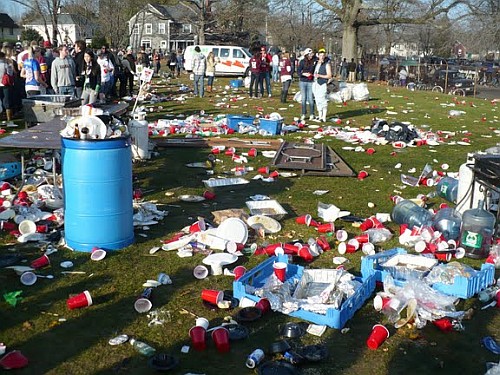
Deadspin ran its own Harvard-Yale gallery, but here are a few I snapped myself. If nothing else, they’ll serve as a reminder that The Game attracts more than just doltish undergrads.

[But doltish undergrads are the most fun, aren’t they?]


Lewis Hyde Practices What He Preaches

[The Millions]

Over at The Millions, I’ve got a post on Lewis Hyde and his absurdly overlooked “Frames from the Framers: How America’s Revolutionaries Imagined Intellectual Property.” It’s a great essay with real-world relevance—both to downloading music, which Hyde examines in the essay itself, and to the Google Books settlement, which he takes up (with some of the same quotes and ideas) in this recent NYTBR essay.

I’m actually working on a longer story on Google Books (more specifically, on its covert scanning operations in . . . Indiana!), and I’m starting to think that Hyde’s idealism might hamstring him there in the same way it does in his “Frames from the Framers.” But we need more idealists, not fewer.

You can download Hyde’s entire essay here.

Why Are Were Artists Poor?

[x-posted at The Rumpus]

Reading Jeremy Hatch’s post on Andrew Keen and starving artists, I couldn’t help but think of Joel Barlow (1754-1812). Barlow was a poet, one of the Connecticut Wits, to be precise, so my mental leap probably owes more to the fact that I was reading Barlow right before I clicked over to The Rumpus than to anything else.

Still, there is a connection. In 1783, Barlow wrote a letter to Elias Boudinot, the president of the Continental Congress: “As we have few Gentlemen of fortune sufficient to enable them to spend a whole life in study, or enduce others to do it by their patronage, it is more necessary, in this country than in any other, that the rights of authors be secured by law.”

At this point, America didn’t have anything resembling modern copyright law—England had just finalized its pioneering policy in 1774—and Barlow outlined how this was hampering artists like Timothy Dwight, future president of Yale and current author of The Conquest of Canaan. The Conquest of Canaan was perhaps the first American epic poem, “a work of great merit,” according to Barlow, though it’s probably better described as “ambitious.” Dwight had been sitting on his creation for six years because, in Barlow’s words, “the Author cannot risque the expences of the publication, sensible that some ungenerous Printer will immediately seize upon his labors, making a mean & cheap impression [i.e., an edition], in order to undersell the Author & defraud him of his property.”

In what now seems like a rather silly instance of “states’ rights,” Connecticut passed its own copyright law in 1783. Slowly, the other states followed, with national copyright coming in 1790. But copyright was only the first step to solving Barlow’s problems—authors still had to find a way to earn a living, as William Charvat argues in his Profession of Authorship in America: 1800-1870, where I first encountered Barlow’s story.

Charvat’s book is now an academic classic—the library copy I’m reading has more pencil in it than a third-grade classroom—even though he never finished it. Charvat died at 61, leaving behind a jumble of papers and notes and a preliminary table of contents. His colleagues at Ohio State came together and forged a fitting tribute. Matthew Bruccoli, a young professor who would become the world’s top Fitzgerald scholar, edited the text as best he could, using a system of brackets to mark materials Charvat “may have intended to delete or shift or rewrite,” as Howard Mumford Jones explained in his “Foreword” to the book.[1]

Anyway, Charvat shows how early American authors, far from receiving advances, actually had to pay to publish their works. Authors fronted the money, publishers distributed the product, and nobody made a livable wage. Barlow ended up working as a chaplain in the Continental Army and writing The Vision of Columbus, his own ambitious epic, on the side. The best an author could hope for was to sell subscriptions to his potential masterpiece based on a prospectus. (Here, the military bailed Barlow out again: 117 of his 769 subscribers for The Vision of Columbus were officers.)

Barlow was one of those unfortunate souls who outlive their art. But he deserves credit for being perhaps the first American to talk about the financial realities of writing—and at a time whenĀ his gentleman friends considered such talk tawdry and cheap.

Today, of course, we talk (and tweet) about little else. I find it reassuring to remember that people—thinking, breathing, 3-D people—have worried about protecting copyright, finding an audience, and getting paid for a long time.

————————————

[1] Jones’s “Foreword” is a fascinating document in the history of academic criticism, if you’re in to that sort of thing. The Profession of Authorship in America came out in 1968, two years after the game-changing “Languages of Criticism and Sciences of Man” conference. Jones does praise Charvat’s “rational scholarship” and “objective research,” but, when it comes time to attack the opposition, he still goes after the New Criticism and the Northropean archetypes. Either way, Jones was right to play the underdog; he mentions “a famous [contemporary] American publishing company which, on moving from its old location to its new one, dumped its back records without regard to their historical worth for scholarship,” and Charvat’s methodology and concerns didn’t get their due until more recently. Thankfully, we’re now seeing something of a Charvat renaissance; Ohio State even named its special collection of American fiction after him.

Prepreprofessionalism

The academic journal College Literature just published my essay on applying to grad school. You can read it here on Project MUSE, or visit this site’s archive for an open-access .pdf.

As in most academic publishing, this took positively forever to come out—in between my final revision and the issue’s printing, U. S. News & World Report not only issued two new sets of grad-school rankings, it also ceased to be a print publication (with the exception of best-selling special issues like said grad-school rankings). Underscoring this lag is the fact that my essay’s subject is a group of online message boards that discuss applying to grad school. These were very real-time and very soul-crushing, as I remember them, but we applicants couldn’t stop talking about rankings, publishing, conferencing, and everything else.