But will she listen?

I’m still working on my essay on political scandal, and that work is still producing wacky asides. This one comes from Richard Strout, who reviewed Time columnist Hugh Sidey’s book on Lyndon Johnson, A Very Personal Presidency, for the New York Times Book Review in 1968:

Superficial, uniformly interesting, it is written in the slick, lucid Time-Life style and is crammed with quotable paragraphs that you want to read aloud to your wife.

Well, then. At least Time put Phyllis McGinley on its cover in 1965. She was the only woman writer to get that honor in the 1960s.

In which I finally find a reason to post about Chelsea Clinton’s wedding

One of the most influential legal articles ever written — and an article I keep running into since I’m working on an essay about political scandal — is Samuel Warren and Louis Brandeis’s “The Right of Privacy” (1890). “The Right of Privacy” still surfaces in even non-academic settings, as in this recent New York Times Magazine story on privacy in the Internet age:

Samuel Warren and Louis Brandeis complained that because of new technology — like the Kodak camera and the tabloid press — “gossip is no longer the resource of the idle and of the vicious but has become a trade.” But the mild society gossip of the Gilded Age pales before the volume of revelations contained in the photos, video and chatter on social-media sites and elsewhere across the Internet.

You can make a strong case that the shameless coverage of political weddings — Warren to Mabel Bayard (daughter of Senator Thomas F. Bayard); Grover Cleveland to Frances Folsom (a friend of Mabel’s); and several others within Warren’s family — led to the writing of “The Right of Privacy.” In fact, Amy Gajda makes precisely this case in “What if Samuel D. Warren Hadn’t Married A Senator’s Daughter?” [pdf]. Gajda’s essay makes for a fascinating and accessible read — especially in the context of all this saturation-point publicity surrounding Chelsea’s wedding.

Review of Sam Munson’s The November Criminals

[Wall Street Journal]

In tomorrow’s Wall Street Journalonline tonight!—I’ve got a review of Sam Munson’s first novel, The November Criminals. About the only bad thing I can say is that its page numbers are basically unreadable. (See for yourself on Google Books.)

One point I try to raise in the review is how and why we might think of The November Criminals as a “conservative novel.” The best broad take on this topic remains Benjamin Nugent’s, which appeared a couple of years back in n+1. Munson fans might also listen to this interview with him on The Forward‘s website. He sounds like another Jewish stoner funny man, Seth Rogen, to an uncanny degree.

What Is a Ghostwriter?

[Los Angeles Times]

In today’s Los Angeles Times, I’ve got an op-ed that is, among other things, a quasi-defense of political ghostwriting. I start with an anecdote about Eleanor Roosevelt and her first lady memoir This I Remember (1949), and one point I want to make is that these issues have been with us for a while. After all, Bess Truman, Eleanor’s successor, told a reporter in 1952 that “everyone else connected with Washington has written a book. I am certainly not going to compound the felony!”

A few weeks back, I wrote a separate essay for The American Prospect arguing that most readers, historically, haven’t cared about ghostwriting. Even today, when a political book’s behind-the-scenes details get served up as news, ghostwriters matter only as an extension of their clients. (Sarah Palin’s ghostwriter was widely criticized, but who can name Joe Biden’s?) Still, there are a few people—usually professional writers—who get worked up about ghostwriting. The Times op-ed is aimed at them; I think it also works nicely as a counterpoint to my Prospect essay.

One other thing: in addition to her 20-plus books, Eleanor Roosevelt also wrote for magazines and newspapers. I highly recommend her “My Day” column, and, thanks to The Eleanor Roosevelt Papers Project, you can read them all online. Just on the subject of This I Remember, you’ll find columns on Humphrey Bogart asking for an autographed copy and on Eleanor’s writing process (and note there her casual, authorial repetition of “I”). But one column in particular resonates with both the op-ed and my recent New York Times essay on the history of the first lady memoir. On November 11, 1949, Eleanor writes:

I have just been told that though the manuscript of my book as it appeared in McCall’s did not make a mistake, there is one in the book which I hope can be corrected in future editions. In some way a slip was made in referring to Mrs. Mary McLeod Bethune as “the late” Mrs. Bethune. Since she is now trying to raise large sums for her college and is most active, I am sure I could not have overlooked such a mistake. But one never can tell what one’s eyes will do when one had read a manuscript many, many times. I only wish here to apologize to her and assure her that it will be changed in the future editions.

Great Moments in Advertorial History

I’m wrapping up an essay on the history of the first lady memoir (and wishing I had about a million more words for this topic), but I had to stop and share this ad. It ran in the November 15, 1949 edition of the New York Times (along with a bunch of other newspapers), and it champions a forthcoming issue of McCall’s.

The ad is visually arresting—not only in its own terms, but also in its similarity to the slippery Gawker-like campaigns you see all over the web today.
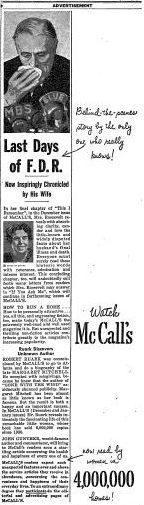
Here’s a detail of the top:
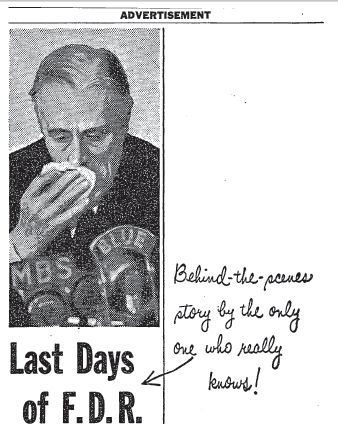
Here’s the first paragraph of the ad:

In her final chapter of “This I Remember,” in the December issue of McCALL’S, Mrs. Roosevelt reveals with absorbing clarity, candor and love the little-known and widely disputed facts about her husband’s final illness and death. Everyone must surely read these historic words with reverence, admiration and intense interest.

Here’s a description of the magazine more generally (ellipses in the original):

HOW TO RUN A HOME . . . How to be personally attractive . . . yes, all this, and engrossing fiction, too, make today’s McCALL’S the extremely well-read and well used magazine it is.

The last bit of faux-handwritten marginalia is McCall’s slogan from this period: “Now read by women in 4,000,000 homes!”