The Real (Literary) America

[The Millions]

Over at The Millions, you’ll find my “dispatch from the Borders-land,” where, basically, I ask a bunch of shoppers about their relationship to books. Lit blogs tend to take an isolated view of the literary world, and I wanted to push back against this (and also to satisfy my own curiosity). The week I did the interviews—this was back in December, and the story’s delay stems mostly from my incompetence—the New Yorker debuted another excerpt from DFW’s The Pale King. I remember being extremely excited to read the short story, then noticing that the magazine’s newsstand appendage thingy didn’t even mention Wallace. Different worlds, different priorities—and yet, among the people I talked to, fiction seems alive and well.

One caveat: I wanted this dispatch to be short and I wanted to devote most of it to the interviews, so if it seems like I’m totalizing “real” or “average” readers (or relegating them to scare quotes), that’s why. With more space, I would have liked to talk about the geographic and socioeconomic aspects to reading audiences. For example, Connecticut Goodwills tend to offer some pretty interesting books (in the last year, I’ve picked up an early edition of JFK’s Profiles in Courage and a paperback of William Vollman’s Europe Central). I don’t recall Indiana Goodwills even selling books.
Cheshire’s Library Controversy

[New Haven Advocate]

In this week’s Advocate, I’ve got a story on Brian McDonald’s In the Middle of the Night, a true-crime take on the horrific Cheshire home-invasion case from a few years back. The story ended up focusing on the reaction to McDonald’s book as much as the book itself—especially when local residents started calling for the library to ban the book and launching ugly personal attacks at the head librarian. As I write in the story:

Let’s be clear: The only real villains in this mess are Komisarjevsky and Hayes, and, even three years later, it’s impossible to consider Petit’s tragedy without feeling fear, sympathy, and regret. But this tragedy occurred in and was assimilated by a culture that loves lurid details, easy-bake opinions, and petty personal concerns. And, in the reaction to McDonald’s book, you’ll find this culture’s usual suspects—duplicitous lawyers, lazy journalists, small-town politicos, quickie cash-in publishers, and a whole lot of people who’d rather react than read.

One thing I couldn’t work into the story was more on McDonald’s own career, which is fascinating. He described himself to me as “a reluctant true-crime writer” who took on In the Middle of the Night (and a previous entry in St. Martin’s True Crime Library series) “simply because I needed the work.” But McDonald’s far from a hack. He’s written three other books, including My Father’s Gun, a well-reviewed memoir about his family’s three-generation history with the NYPD. And I’d argue that, other than its poor pacing and organization, In the Middle of the Night also demonstrates his talents—as I say in the story, it’s a solid entry in the true-crime canon.

Of course, the only way you’d know that is if you actually read McDonald’s book.

N.B.

[New Haven Advocate]

Good news about the media is rare, and, when it occurs, it’s tempting to just nod and slowly back away. That’s basically what happened when Michael Schroeder rescued several small-town Connecticut newspapers in 2008. The New York Times, the Wall Street Journal, and other national organs jumped on his last-second bid. Since then, though, no one’s checked in to see how he’s changed the papers—or if he’s got a realistic chance at turning them around.

My new cover story at the New Haven Advocate tries to remedy that. James Smith, Schroeder’s top editor, gave me free reign in his newsroom at the New Britain Herald (“I like cooperating with the free press,” he said), and I spent a couple of days talking to reporters and readers, in addition to Smith and Schroeder.

In the last few years, Connecticut newspapers have lost local readers at a much faster clip than the rest of the country, so the state of the Herald might offer some clues for other areas. Of course, everything’s shifting quickly—that link, to a Hartford Business Journal story from 2007, names the big papers as hot buys and the small ones as toxic assets. At the very least, though, Schroeder’s Herald offers a chance to study a smaller paper, instead of the NYT– and WSJ-level stuff that dominates so much of the metamedia discourse.

Here’s some context I couldn’t work into the story.

  • As I mention in the story, New Britain newspaper readers split between the Herald and the Hartford Courant. No one’s more excited that 2009 is coming to a close than the Courant. In the last year, America’s oldest continually published newspaper lost its top two editors, its Washington bureau, its top local political reporter, and, in the most public embarrassment, George Gombossy, the consumer columnist who says he lost his job for writing stories critical of Courant advertisers. Not surprisingly, the Courant‘s also lost more than 20,000 subscribers in that same period—including one New Britain man who told me about the time Gombossy helped him get his money back from a local Best Buy.
  • If you’re interested in the sordid history of the Journal-Register Company, which, from 1995 to 2008, owned and tortured the Herald, start with this great American Journalism Review story. This Philadelphia CityPaper story outlines the JRC’s nasty reaction to that story;  this Forbes feature is also worth reading. As I mention in my story, the JRC promised to make only “minimal changes” when they bought the Herald—then laid off a dozen people in their first week.

A Brief History of the Mall Kiosk

[Slate’s The Big Money / The Washington Post]

We all avoid mall kiosks, and we also ignore them. If they pop up in print, it’s generally in a cornball book of get-rich schemes, right next to collecting baseball cards and selling water purifiers. In my new story at Slate’s The Big Money, though, I try to show that kiosks and their employees face more obstacles—and deserve more respect—than you might think.

Too bad I can’t say the same for baseball cards. In the Connecticut mall where I reported this story, the only sports memorabilia store was in the process of closing down (“9 days left”).

Sex, Lies, and Athletic Tape

[Deadspin]

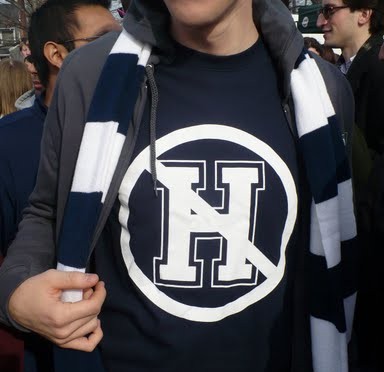
Over at Deadspin, I’ve got a dispatch from this year’s Harvard-Yale game. It’s the 126th time the two have met, and, in both pretension and pageantry, it lives up to your expectations. One of my favorite details from this story was the dust-up over an (allegedly) politically incorrect T-shirt created by Yale students. The administration ended up pushing this anodyne design on the students—but not on too many, judging from the small number I saw at the tailgate.

I’ll include some more photos at the end of this post, but, first, here are a few things I couldn’t fit in. (I should also mention the many helpful books on Ivy League sports—and the fact that, with only two days to turn this story around, I had to skim most of them for the football sections. If the Matt Maloney era at Penn taught us anything, though, it’s that Ivy football is not alone.)

  • Speaking of books: near the end of my story, I mention The Only Game That Matters, a humbly titled history of Harvard-Yale football. Even with its hyper-literate potential audience, this book sold only 3,200 copies (Nielsen Book Scan) and is now out of print—another example of the Harvard-Yale rivalry producing more hype than results. I will point out that, in my copy, checked out from Yale’s Sterling Memorial Library, someone had enthusiastically underlined and starred a passage about how Harvard and Yale’s history predates the United States’. Another passage getting the underline-star treatment? “Beating Harvard was, is, and always will be the yardstick by which joy is measured in New Haven.” This, of course, is complete baloney.
  • One person I talked to while working on the story was Jim Fuller, who covers the Yale football beat for the New Haven Register (and runs a nice blog on the same subject). In 2009, the Ivy League replaced its annual media day with a conference call, and Jim argued that this decision will further diminish the League’s relevance. Last year, when a victory over Yale would have given Brown a share of the Ivy title, the Bears’ coach didn’t even come out for interviews because no local media showed up. One other metamedia note: I found it fascinating how many of these odes to the Ivy League mentioned the success former players were having on Wall Street. We’ll have to see how the post-populist coverage of The Game evolves.
  • Let me also draw your attention to “Yale and Athletics” [.pdf], a 1980 address delivered by Yale president A. Bartlett Giamatti. Giamatti—professor of English, commissioner of baseball, and father of Paul—offers a knee-buckling display of erudition. Citing everything from a decade-by-decade comparison of Yale varsity sports’ winning percentage to a long passage from John Henry Newman, Giamatti lays out college athletics’ twinned heritage from the Greeks and nineteenth-century English educators. He also offers some refreshing transparency: “We need always to recall that the production of revenue is as much a part of the picture of Yale athletics as the provision of services and opportunities.”
  • From Bartlett to some quotations overheard at this year’s tailgate: “I was just last weekend at the Stanford-USC game. It’s been a big eight days for me!”; “Man up! It’s Harvard-Yale. Man up!”; “Look, it’s Jeremy Shockey” [This was a Harvard frat guy calling out a Yale frat guy, and I have to say: Yale students struck me as about 30 percent more grating, though this might have been some kind of home-field advantage].

Deadspin ran its own Harvard-Yale gallery, but here are a few I snapped myself. If nothing else, they’ll serve as a reminder that The Game attracts more than just doltish undergrads.

[But doltish undergrads are the most fun, aren’t they?]