The Technician: A Profile of Rick Moody

[New Haven Advocate]

In this week’s New Haven Advocate, you’ll find my profile of Rick Moody and his new novel, The Four Fingers of Death. (Moody writes such disparate books that it’s tough to pick a best [or a worst], but I can say that The Four Fingers of Death is easily my favorite.) One thing Moody and I touched on—and one thing the blogosphere’s been bandying about—is the idea that regional lit has sort of disappeared. Moody grew up in and around New Canaan and made his name with The Ice Storm, which savaged the affluent suburb, so he brought an interesting perspective to this. Since we didn’t have room to include the material in print, I’ll post some of it here.

One of the funniest things about the film adaptation of The Ice Storm is that New Canaan’s officials didn’t read the book before agreeing to let Ang Lee shoot it in town. When they finally got around to reading Moody’s novel, the townsfolk were scandalized. The New York Times, as you might imagine, was all over this story, and Moody promised the paper that “although [The Ice Storm] was set in New Canaan, it could have been anywhere.” So I started this line of questioning by asking him if, in these calmer times, he still believed this was true. “There are plenty of suburbs in the Northeast that could have stood in,” Moody said. “The larger question is, could it be set in a different time. There were social conditions that made that story what it was, both in real life and in the time of its writing.”

Still, when Moody talked about his next move, he framed it in geographical terms.

After The Ice Storm, I had to work really hard and really fast to not be ghettoized as a surburban writer of the Northeast. In some ways, there were readers who wanted me to serve that function, a preservationist role as a fiction writer for these towns and those socioeconomic strata. But why would you want to do that as a writer? Why would you want to limit your imagination?

Moody used Updike as an example of someone who could capture a place (the Rabbit books) without allowing himself to be limited to or defined by it. Moody also suggested some economic reasons, in addition to any creative ones, for the decline of regional lit:

Nobody wants to be limited to that market. You don’t want to be the bard of Fairfield County, especially given the economic pressures of making a living and of trying to be published by a big publisher. The big publishers select certain kinds of material, and it’s really hard not to get drafted into their model of how to do this. They want the writing workshops to do what the writing workshops are doing. Especially now, the book publishers are risk averse—they want to be able to quantify what a novel’s going to do, and it’s easiest to do that if they can speak to have it having particular effects and doing particular things. That’s why genre fiction is important to them. They pay lip service to the emotional relationship that they have, as editors, to literary fiction. But it’s still easier for them if it all does a certain thing—which is affirmational, epiphanic, realistic.

I’ll admit that I don’t see a direct link between the first part of Moody’s argument and the second, though I do see some connections to his argument against “creative writing by committee.” (Note how much milder that was around the release of The Ice Storm.) Still, it’s interesting to see a case against writing regional lit come from a writer so closely associated with his home state. In fact, Moody wrote the Connecticut chapter in 2008’s State by State: A Panoramic Portrait of America. It begins: “Connecticut is a state that’s hard to love, but which I love anyhow, as one often loves what wounds—if only for the familiarity.”

Lebronnukah

[Deadspin]

Over at Deadspin, I’ve got a dispatch-slash-photo gallery from last night’s LeBron James television special, which was staged in Greenwich, CT. The special generated tons of coverage in both the standard and Watching-the-Watchmen traditions, but I tried to focus on how the media manufactured and replicated its stories. You don’t need to blame anyone at this event to admit that the media ecosystem deploys its resources in a mysterious way.

If you like the story, you might also like the first thing I wrote for Deadspin—another investigation of media malpractice, this time about the story of a 9-year-old pitcher banned by his baseball league for being “too good.”

Also, the real winner in all this, to my mind, is Kobe Bryant—he’s no longer the NBA’s Iago.

Welcome to the Wide World of . . . Urban Squash?

[New Haven Advocate]

In this week’s New Haven Advocate, I’ve got a long story on Squash Haven, a local nonprofit that follows the after-school orthodoxy except for one thing: its kids play squash. This focus raises some obvious questions (namely: Why turn to such an expensive and elitist sport?), and I try to touch on them in the story. Still, the people at Squash Haven are doing great work and getting great results. It’s tough to question that.

I should add that the story might seem a little fractured or jumpy since, for a lot of reasons (most of them my fault), the reporting dates back to 2008. I did go back this month to check on my group of middle schoolers, and several of them are heading to a national squash tournament. I’m sure they—and Squash Haven as a whole—will do New Haven proud.

Mark Twain’s Many Mansions

[New York Press]

In this week’s New York Press, I’ve got a story about Mark Twain’s long-forgotten residence in Greenwich Village—and the 1954 crusade to save it. I first discovered this while doing some research (on one of these) for grad school stuff, and I quickly became obsessed with it. As you’ll see in my Press story, though, things got really interesting when I tracked down one of the story’s main players—a British film director who happens to be celebrating his 99th birthday this week. (This week also happens to be the centenary of Twain’s death; they just missed each other.)

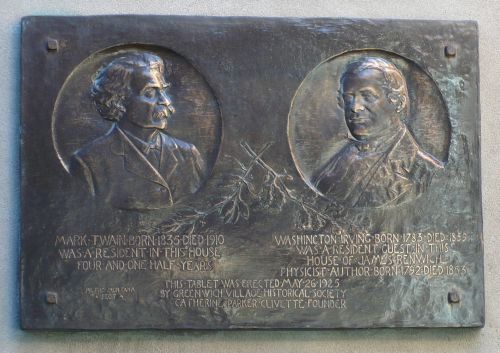
Anyway, the story’s obviously a New York-centric one, so, in deference to all the non-New Yorkers out there, I thought I’d share some photos I took while reporting this. Up top is the plaque—still there at the corner of Fifth and Ninth in Manhattan—that the Greenwich Village Historical Society set up in 1925. (Clara, Twain’s daughter who put up the “NO BILLIARDS AFTER 10 P.M.” sign, was at the ceremony.)

Here’s another 1840s townhouse a few blocks over from the site of the Twain House. (The Twain House, thanks to its architect, included more flourishes than this house: stained glass windows, Romanized details, and a whole lot of wrought iron.)

Here’s the faux-historical sign the developers slapped on the “tall ultramodern apartment building.”

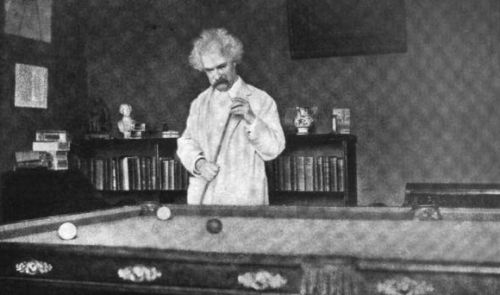
And here’s Twain at 21 Fifth Avenue, chalking his cue. There are a ton of great photos like this in Paine’s three-volume biography, which is available on Google Books. Here’s the third volume, in which, at several points, Paine signals that Twain was a bit of a cheater.

A Brief History of Ghostwriting

[The American Prospect]

In the May issue of The American Prospect, I’ve got an essay on the long, distinguished history of political ghostwriting. A few recent books have touched on this subject, including Robert Schlesinger’s White House Ghosts and Ben Yagoda’s Memoir: A History, but it’s a rich one. My essay, for example, mentions Doris Kearns Goodwin only in passing, but there’s a lot more story to tell.

In fact, Rick Perlstein told it wonderfully in a 2002 essay for the Village Voice. That publication’s notorious website swallowed the essay long ago, but you can still find it via the Wayback Machine. It’s worth reading in full—not only as the best thing written about Goodwin’s plagiarism fiasco, but also as a great meditation on the act of writing history. Here’s a sample:

Historians must write in the grip of an abiding fear. Composing a paragraph one imagines two audiences: the everyreaders, and the three or four people who know more about what you are writing in a particular paragraph than you do, who have read any book you’re inclined to plagiarize, who, for God’s sake, may have written the book you’re inclined to plagiarize. . . . My book is about the 1964 Barry Goldwater election. And the thought of a midnight knock on my door from this guy named John Kessel (who may or may not still be alive), who published a fine academic study in 1968 called The Goldwater Coalition: Republican Strategies in 1964, accusing me of doing him any dishonor, sends chills down my spine.

I’ll add here that, in an age when plagiarists blame their sins on computers and mixed up research files, it’s fun to read Goodwin preaching about reform through “modern technology.” “I now rely on a scanner, which reproduces the passages I want to cite,” Goodwin promises. “I keep my own comments on those books in a separate file so that I will never confuse the two again.” Maybe more relevant to my Prospect essay is the reliance of Goodwin (and plenty of other pop historians) on research assistants. As of 2002, Goodwin employed four—what’s the best term here? Ghostreaders?