Reagan and/as Palin

[Los Angeles Times]

In today’s Los Angeles Times, I’ve got an Op Ed on Sarah Palin’s constant invocations of Ronald Reagan. Every Republican does this, of course, but I argue that Palin invokes Reagan in a uniquely shallow way. In fact, her use of Reagan mirrors the Tea Party’s use of the Founding Fathers, and I suspect my thinking on Palin owes a lot to Jill Lepore’s book about the Tea Party.

It doesn’t hurt that Palin connected all the dots in a recent essay for the National Review:

The Tea Party reminded us that Reaganism is still our foundation. I think the Gipper is smiling down on us today waving the Gadsden Flag.

The Drudge Report and Bush’s Decision Points

[New York]

In this week’s New York magazine, I’ve got a short little essay arguing that presidential memoirs exist not to be read so much as to be discussed. That’s clearly the case with Bush’s new Decision Points, though the full details of his TV tour didn’t surface until after my story had gone to press. Still, the history of this genre — or, more accurately, the history of the promotion of this genre — gave me more than enough to go on. Bush’s book, like all presidential memoirs, will matter less as a weighty tome than as a multimedia launching platform. While all of the media depend heavily on books — think of the forthcoming reviews, Op Eds, and blog posts digesting Decision Points’ greatest hits — the most important format will be the least bookish: television. At one point in my essay, I mention the now-forgotten TV genre of the “electronic memoir.” Well, there’s no need to sell an electronic memoir when a book will accomplish the same thing: getting you and your message on TV.

That’s what’s happening with Bush’s presidential memoir, and that’s what’s been happening since Truman’s. Still, there are a few new things about the promotion of Decision Points: a book trailer; an elaborate and viral-friendly Facebook contest; and what sounds like an amazing ebook, which will include the text of Bush’s speeches, some of his home movies, even handwritten letters and extra photos. (Decision Points won’t be the first presidential memoir ebook, surprisingly enough — there was a palmOne edition of Clinton’s My Life.) But the weirdest digital aspect of this is that the first real details from Bush’s book appeared on The Drudge Report. Media reporters got pretty sloppy here: most of them described this as a “leak,” and some even assumed Drudge had the entire book. But there’s no reason to believe any of that. After his “**Exclusive** **Must Credit**” throat clearing, Drudge wrote:

“It was a simple question, ‘Can you remember the last day you didn’t have a drink?'”

So begins President George W. Bush in the opening chapter [“Quitting”] from the most anticipated book of the season, the DRUDGE REPORT can reveal.

Drudge wouldn’t respond to my requests for comment. But that “can reveal” seems pretty telling. In fact, if I had to bet, I’d say Crown leaked him this information directly. The publisher’s employees haven’t kept especially quiet about Bush’s book (for example). And they can’t be unhappy with what Drudge wrote. Indeed, when it comes to leaks, Crown couldn’t have — I don’t even know what the right metaphor is anymore: scripted? written? — a better result.

By Committee

[New York Times]

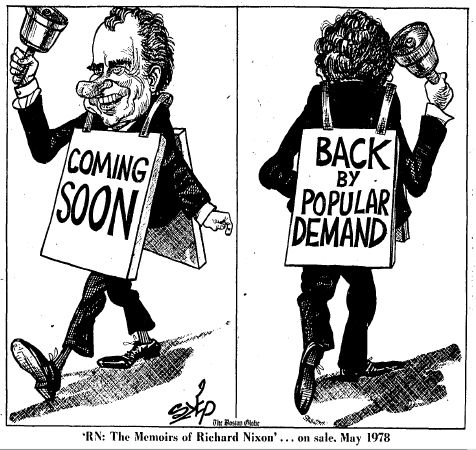
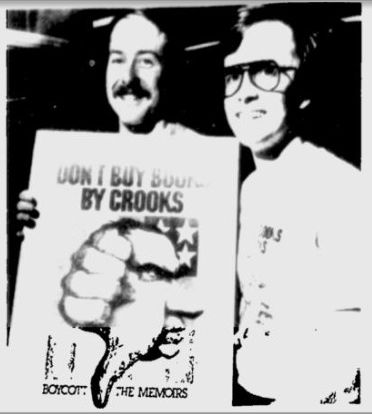
In this Sunday’s New York Times Book Review — and just in time for the release of George W. Bush’s memoirs — I’ve got an essay on the crazy (but long forgotten) protests surrounding the release of Richard Nixon’s memoirs. My cast of characters includes Tom Flanigan and Bill Boleyn (pictured above), the co-founders of the Committee to Boycott Nixon’s Memoirs, and Sid and Esther Kramer, the co-owners of Westport, CT”s Remarkable Book Shop (pictured below). Really, though, it includes just about everyone living in 1978 — because RN: The Memoirs of Richard Nixon came with a degree of media hype achieved by no presidential memoir before or (so far) since.

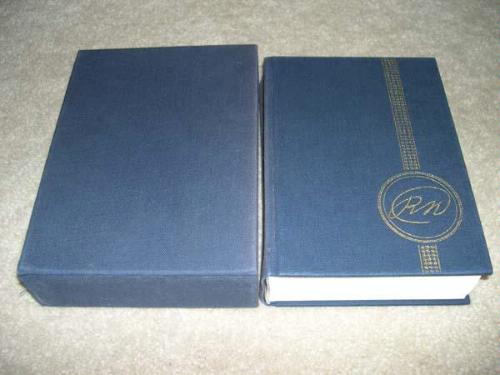
For further proof of this, check out this contemporary news broadcast (YouTube) and, below, some great caricatures of Nixon as author. I also wrote a blog post for the Times about the two “deluxe” editions of Nixon’s memoirs — this phenomenon of presidential publishing also occurred with Carter’s, Reagan’s, Clinton’s, and, now, Bush’s books — and there are some images of those editions. After that, as promised, a few old newspaper photos of the Remarkable Book Shop. Sid told me that, when the RBS closed in 1993, Paul Newman called him and said, “Don’t close — you can’t close.”

The New Republic (1974)

The New Republic (1978)

Boston Globe (1978)

*  *  *

RN‘s $50 “deluxe” edition, with slip case

RN‘s $250 “numbered presentation” (and
leather-bound and gold-detailed) edition

The “numbered presentation”
edition’s certificate of authenticity

The first volume of Warner’s paperback edition ($2.95)

*  *  *

The RBS in the 1960s (Dan Woog)

New York Times (1994)

New York Times (1987)

New York Times (1994)

Jimmy Carter’s Second, Polished Draft of History

[San Francisco Chronicle]

Two days before Jimmy Carter’s inauguration, Art Buchwald used his “Capitol Punishment” column to offer some advice to the incoming administration. “The first thing to do when you get to Washington,” Buchwald wrote, “is find a literary agent. The second thing is to buy a four-year diary and fill it every day with vignettes about the mistakes made by the people you work with in the administration. It is never too early to start writing your book.”

I can’t think of a better gloss on Jimmy Carter’s literary career — a career that now extends to White House Diary, his 26th book, which I review in Sunday’s San Francisco Chronicle. The book’s other reviews, as political book reviews so often do, focus on checking Carter against the historical record and drumming up his juicy details. There’s nothing wrong with this approach, except that it doesn’t really work with White House Diary because the book includes so little that’s new. The two stories whirling around the political news cycle — Carter’s belief that the Iran hostages cost him the 1980 election and that Edward Kennedy sabotaged his health care proposal — both appeared 28 years ago in Carter’s Keeping Faith, albeit in slightly milder form. That’s why, in my review, I tried to talk about White House Diary as a diary — as a specific kind of book that readers approach with specific expectations and specific standards. From this perspective, White House Diary is an almost total failure. I never thought I’d have a reason to recommend Keeping Faith (still in print, by the way, as is Carter’s much better Why Not the Best?). But I submit that it’s a more coherent and less manipulative picture of Carter’s presidency.

I do want to expand on two statements in my review. First, I talk about the the growing genre of presidential diaries. While Reagan and Carter were the only twentieth-century presidents to keep consistent diaries, just about all of them dabbled in it. (Many of them also saw their diaries subpoenaed, which explains why recent presidents have kept quiet about their diaries or opted for an alternative — Bill Clinton’s conversations with Taylor Branch, for example.) Truman kept a sporadic diary, as did Eisenhower. Nixon kept a daily diary for 20 months and quotes from it about 150 times in RN: The Memoirs of Richard Nixon. For a while, George H. W. Bush kept a diary as vice president, and he tried (and lapsed) again as president. (Bush was more faithful as a young man in China.) There’s also the related genre of “presidential daily diaries,” the official, obscenely detailed logs of a president’s activity. Carter’s daily diaries often start with this: “5:00: The President received a wake up call from the White House signal board operator.” These documents include entries for the briefest of meetings, every single photo op, even one-minute phone calls. You can browse Carter’s here, along with Gerald Ford’s, Lyndon Johnson’s, and many more presidents on their libraries’ websites. (I won’t get into the pre-Truman diaries, but here’s one fun example: the Massachusetts Historical Society updates a Twitter account with entries from John Quincy Adams’s diaries.)

The second thing I want to touch on is my comparison of Reagan’s and Carter’s diaries. None of the afore-linked reviews make this connection, but I hope my review shows how important it is. (It’s also important to compare a president’s diary with his memoirs. In 2004, plenty of The Reagan Diaries‘ reviewers chuckled at its spelling; as Reagan explains in An American Life, though, he developed a loose and unorthodox system while delivering multiple daily speeches for General Electric. “Of course, this hasn’t done much for my spelling,” in Reagan’s example, becomes “cours ths hsnt don much my splng.”) Reagan’s diary was a huge best-seller in 2004, and I think this comparison suggests one reason Carter resurrected his diary. But the Carter reviewers’ omission of Reagan as a counter-example illustrates something else: how, despite all the noise about their value as history — and this noise normally tops out right after a leak of the president’s megamillion dollar advance — how shockingly disposable these books can be.
Bob Woodward’s New Book

On Monday, Bob Woodward’s latest book, Obama’s War, will hit stores in Washington, D.C., and everywhere else. As so often happens with high-profile political releases — in fact, I talked about this in my recent story on the digital leaking of Jimmy Carter’s White House Diary — a media outlet got an early copy of Woodward’s book and ran a story summarizing its juiciest details.

As so often happens, that outlet was The New York Times. Politico’s Keach Hagey has a great story on how it all went down, a story in which she kindly quoted me. The only thing I’d add to Hagey’s take is that this sort of thing has a long and equally intense history. Take Woodward (and Carl Bernstein’s) first book, All The President’s Men. It came out on June 17, 1974, but by early April newspapers across the country were running multiple-page stories summarizing the excerpts in Playboy. (The magazine paid $20,000 for two long excerpts from All The President’s Men, which ran in the May and June issues.) Books get fewer big serialization deals these days — I’d guess the online circulation of both the serializations and the summaries had more to do with this than the stories themselves — so the summaries now latch on to the books. And this happens with all kinds of political books: the Times got there first with Bill Clinton’s memoirs, Laura Bush’s memoirs, and Woodward’s last book, to name only a few.

What is new — and pretty fascinating — is the way new media are interacting with books. My story about Carter’s diary and Google Books is one example. Another is Politico’s Woodward fixation: the publication ran 8 separate insider-y stories on Obama’s Wars in the first two days after the Times‘ scoop. That hype sounds unbeatable — until you remember that Woodward and Bernstein sold the movie rights to All The President’s Men a full three months before its release.