Everybody Loves Anonymous

[Los Angeles Times]

In today’s Los Angeles Times, I’ve got an Op Ed on the media furor over O: A Presidential Novel. While the anonymous title doesn’t drop ’til next week, there’s already been tons of speculation about its author. (My guess? If the person “has been in the room with Barack Obama,” why not Tareq and Machael Salahi?) But there’s something telling about this speculation. As I write in my Op Ed,

It’s a good example of the insularity and superficiality that defines the Washington media. It’s also an opportunity to reflect on why anyone would bother writing or reading a novel in the first place.

The O uproar, of course, is also reminiscent of the one surrounding Joe Klein’s Primary Colors. In an August 1995 essay on the decline of the Washington novel, Terry Teachout noted that “addicts with an eye on 1996 have to look forward, among other things, to a Clinton ’92 roman a clef by an allegedly anonymous author said to be a big-time political reporter.” Already, then, Primary Colors was in the air — and the authorial speculation increased as the galley copies went out. In 1996, though, the media waited until the book was out (and until they knew it was decent) before they started wasting other people’s time with this speculation. And that’s the difference.

Now, this isn’t to say that the Primary Colors affair was a positive one, and I’ll expand on a few of the more fascinating low points below. It might not be clear from my Op Ed, but Klein was responsible for plenty of those low points. His excuse for taking five months to fess up was that he owed the silence to his publisher. But several contemporary reports suggest that, by April, Random House wanted Klein to come out because it would create another round of publicity. (The publisher even entered negotiations with People and the Today show.) There’s also the fact that Klein continued reporting on Clinton — and that they had long enjoyed an on-again, off-again relationship. (In 1994, Esquire published a two-year old memo addressed to Clinton: “Joe Klein: He is disappointed in you. As always. He thinks you’re not being tough enough on the real problems. Of course, much of this is a result of Joe’s obvious belief that you are the last best hope of the planet Earth.”)

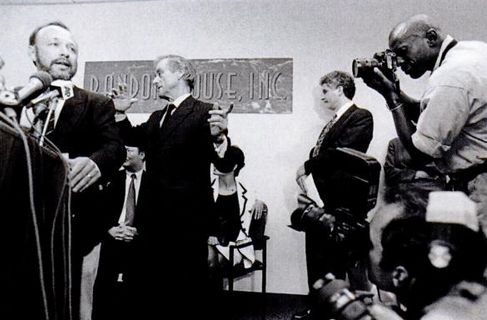
In both instances, Klein tried to have it both ways. And this,  along with some sanctimony — the picture above comes from his confessional press conference, where he invoked Henry Adams several times — seems to have been his main error. Even here, though, Klein was easily outdone by the rest of the media, and more on them in a second. But first, a few more examples of Primary Colors‘ popularity. Klein got $1.5 million for the book’s paperback rights, another million plus for international rights (19 countries!), and another million for film rights. A very conservative estimate of his total take would run to $6 or $7 million. It’s no surprise that, almost immediately, phrases like “the Russian version of Primary Colors” started cropping up (here, in the NYT), or that politicians started saying things like “Now the biggest parlor game in Washington, besides trying to figure out who wrote Primary Colors, is trying to decide whether or not President Clinton wants a real balanced-budget agreement” (here, Bob Dole).

Two more tangents. First, remember that Shakespeare scholar with the computer? Turns out it was Donald Foster. Foster correctly fingered Klein, but, a few years later, saw his name-making claim — that Shakespeare had written 1612 poem, A Funerall Elegyedebunked. Also a few years later, the Primary Colors lawsuit finally wrapped up. In 2005, a New York judge ruled against a woman seeking $100 million because she claimed to be the basis for a librarian who sleeps with Klein’s Clinton stand-in early in the novel. One can understand her frustrations, but one can also wonder why, if they were genuine, she continued to associate her name with the novel through a lawsuit, then an appeal. Either way, the decision itself contains some fascinating stuff like: “Plaintiff argues that Primary Colors was not a work of fiction because it is considered a roman a clef.”

This post is now longer than my Op Ed, so let’s close with the media — and with the Washington Post investigation that finally proved Klein’s authorship. The story, which ran on the paper’s front page on July 17, 1996, was penned by David Streitfeld. Now, I’ve praised Streitfeld on this blog before, but this story was and is nonsense. First, and most obvious, the novel had been out for five months by this point. Second, the paper sank some serious resources into the story. Streitfeld or someone else at the Post (according to Primary Colors‘ paperback afterword) stole Klein’s notebook. This gave them — or rather, the expert they hired — something to compare to the ten words of Klein’s handwriting contained in an early manuscript of Primary Colors, a manuscript the Post purchased from a Washington rare books dealer for several hundred dollars. Third, Streitfeld corroborated the handwriting match with reporting like this:

Klein has been living well, if not exactly lavishly, in the past year. In July 1995, a few months after Random House bought Primary Colors, he bought a $630,000 house in Pelham, a New York suburb, real estate records show.

He took on a $ 310,000 mortgage, suggesting that he plunked down $ 320,000 in cash. Three cars are registered in his name in New York — an Acura and two Fords. The newest is two years old. The gossip at Pelham dinner parties this spring was that Klein’s daughter was boasting at school, “My daddy is rich.”

This strikes me, frankly, as disgusting. It also underscores what must have been a major motivation throughout this whole mess: jealousy.

The Selling of The President, reconsidered

[Salon]

At Salon today, I’ve got a story on Joe McGinniss’s classic of campaign journalism, The Selling of The President. The occasion? Tom Junod’s epic profile of Roger Ailes. Because before Ailes graced the pages of Esquire, he played a key part in Richard Nixon’s campaign — and thus in The Selling of The President. McGinniss’s access to Nixon’s ad men was unbelievable. One reviewer assumed McGinniss had told Nixon’s campaign he was a graduate student; others figured he must have worked for the campaign. As you can see in the book’s advertising (click the image above for a larger view of an ad that ran in the Times Book Review), that access played a key part in the selling of The Selling of The President.

One great tidbit I couldn’t work in: This book made McGinniss into an instant star, and he received a flood of book proposals, potential TV gigs, and so many lecture offers that he had to hire an agent just to deal with them. What McGinniss didn’t do was sell the film rights. Plenty of studios inquired, but he chose instead to allow a theater producer to create a rock musical version (!!!) of The Selling of The President. McGinniss wasn’t involved with the adaptation and ended up souring on it when he found out the script included a couple of egregious plugs for Terminix. It seems the musical got financial backing from an executive with the company. No word on what his department was.

A review of A Black History of the White House

[San Francisco Chronicle]

In tomorrow’s San Francisco Chronicle, I’ve got a review of Clarence Lusane’s new book A Black History of the White House. Lusane’s is a subject worth tackling, though he doesn’t always live up to his material. Slavery crops up all the time in presidential biographies — Joseph Ellis, who isn’t anyone’s idea of the perfect biographer, still managed 70 mentions of “slavery” in his prize-winning book on Thomas Jefferson — but Lusane treats the subject comprehensively. And when he maintains that focus, it creates some interesting juxtapositions and powerful arguments.

While I wasn’t able to locate a copy in time for my review, I did want to flag a similar title: Setting the Record Straight: American History in Black & White. This book comes from David Barton, Glenn Beck’s in-house historian. Given Beck’s previous attempts at history, I’d bet it’s safe to say that something more than the historical impulse informs this book’s findings. And that’s one reason we should be glad for a book like Lusane’s. Despite its imperfections, it contributes to our democratic conversation.

A Review of Edmund Morris’s Colonel Roosevelt

[Boston Globe]

In yesterday’s Boston Globe, I published a review of Edmund Morris’s Colonel Roosevelt, the third and final volume in his TR trilogy. The book’s been widely and positively reviewed, but it still seems to me that most people are failing to appreciate how fascinating and unique and just plain weird Morris is. I give one example in my review that dates back to the writing of Morris’s first book, The Rise of Theodore Roosevelt. But there are many, many more, and I’ve got no idea why anyone was surprised — least of all the Reagans, who put Morris up to it — when Dutch turned out to be an unorthodox book. (It’s an underrated book, too.)

Another example of Morris’s eccentricity came a few weeks back, when he went on Face the Nation to promote Colonel Roosevelt. After Bob Schieffer asked Morris (for a second time) what TR would make of today’s political scene, Morris replied: “You keep asking these presentist questions, Bob. As the immortal Marisa Tomei said in My Cousin Vinny, ‘That’s a bullshit question!'” Morris gave a more precise and politic version of this answer to a Wall Street Journal reporter: “No. Absolutely not. And I don’t speculate on what he would do now if he were alive because that’s just dreamland.” And yet, just two years ago, Morris wrote a wonderful Op Ed for the New York Times in which he crafted a faux-interview with TR out of 2008 questions and historical quotations. Here’s a sample:

Q. Do you blame the House Democratic majority?
A. A goodly number of senators, even of my own party, have shown about as much backbone as so many angleworms.
Q. I hope that doesn’t include the pair running for the presidency! What do you think of Senator John McCain? He often cites you as a role model.
A. He is evidently a man who takes color from his surroundings.
Q. Weren’t you just as unpredictable in your time?
A. (laughing) They say that nothing is as independent as a hog on ice. If he doesn’t want to stand up, he can lie down.

This was surely a send up of the kind of questions Morris has had to deal with during his latest promotional cycle. But it was also further proof that he is someone who has been completely and utterly romanced by the past.

More Mark Twain

[On the Media]

Well, now Mark Twain’s Autobiography has really arrived. On this week’s Saturday Night Live, Bill Hader trotted out his terrific Julian Assange impression. “If I am falsely imprisioned for one more day,” Hader-slash-Assange says, “anyone purchasing Mark Twain’s new autobiography on Amazon as a Christmas present for their father will instead send him the book Everyone Poops.”

The joke makes sense, as enough people are buying the book to keep it on the New York Times best-seller list, hovering between second and third. But Twain’s success started long before the holiday shopping season. This summer, the media came together and anointed the Autobiography’s forthcoming edition as a major literary event. The Times didn’t get there first, but it did put Twain on the front page. And its story is wholly representative: coming this fall, after a century-long embargo, readers will finally meet a realer, darker Mark Twain. A few weeks later, Newsweek devoted its entire cover to Twain and his upcoming book (“Now we must get reacquainted all over again”). Thanks to the coverage in the Times and Newsweek and elsewhere, Twain went viral.

But there’s success, and then there’s success. And Twain’s book has exceeded everyone’s expectations. Plenty of bookstores have run out of copies and had to create wait lists, as the Times noted in another lengthy story. In fact, Twain’s autobiography has become a holiday success story with a full roster of heroes: the author (a serious literary figure), the publisher (an ideas-driven university press), and the printer (a small, employee-owned press based in Michigan). The book got an initial print run of 7,500, but there are now more than 500,000 copies in print — still only a third of the initial print run for authors like George W. Bush and John Grisham, but enough to turn heads even in publishing’s blockbuster age. To keep up with the demand, Twain’s Michigan printer has kept three shifts going — it even rehired some of the people laid off during the recession — and taken to shipping the book off in semi trucks packed with 10,000 copies each.

So, again, it’s a holiday success story, and I don’t want to sound like a literary grinch.  But it’s worth examing how, exactly, the book became such a hit. The media continues to commission tons of reviews, but here, at least, reviews never seemed to matter since the book debuted on the best-seller lists at a time when only one or two had been published. Instead, the book seemed (and seems) to benefit from its pre-release hype — the kind of embargo-powered nonsense that led Saturday Night Live to describe it as a “new” book. A few weeks back, I wrote a story for Slate outlining why the embargo was nonsense, and some of the better reviews — the New Yorker‘s, the Washington Post’s —have also pushed back against the hype. In this week’s Times Book Review, Garrison Keillor goes a step further, in a review that might be best described as affably brutal: Twain’s Autobiography is “a wonderful fraud on the order of the Duke and the Dauphin” and, later, “a powerful argument for writers’ burning their papers.”

I also don’t want to sound like I’m taking credit for this; if you review a 736-page “autobiography” that, thanks to various scholarly apparatuses, amounts to only 264 pages of text, you damn well better point it out. But the bigger point is that nothing the media has done can stop the media’s snowballing hype. Let’s remember that, this summer, the editors from the Mark Twain Project, which handles Twain’s literary estate and receives his royalties, gave the Times a few juicy quotations and some “exclusive” online excerpts of Twain “speaking from the grave.” As recently as 2009, the Project was in deep financial trouble. Clearly, that’s no longer the case — and all it took was the Project sacrificing its scholarly integrity. I’ve had chances to follow up on my Slate story with interviews on CBC’s Q show and on NPR’s On the Media, both of which you can find on my handy new media appearances page.

And speaking of financial trouble: it doesn’t bode well for Tina Brown and Newsweek that I completely missed that cover story while researching my original story.