Sex, Lies, and Athletic Tape

[Deadspin]

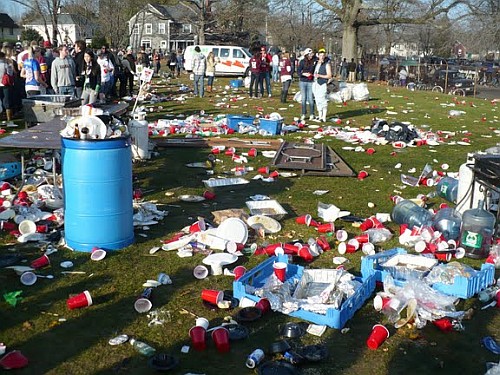
Over at Deadspin, I’ve got a dispatch from this year’s Harvard-Yale game. It’s the 126th time the two have met, and, in both pretension and pageantry, it lives up to your expectations. One of my favorite details from this story was the dust-up over an (allegedly) politically incorrect T-shirt created by Yale students. The administration ended up pushing this anodyne design on the students—but not on too many, judging from the small number I saw at the tailgate.

I’ll include some more photos at the end of this post, but, first, here are a few things I couldn’t fit in. (I should also mention the many helpful books on Ivy League sports—and the fact that, with only two days to turn this story around, I had to skim most of them for the football sections. If the Matt Maloney era at Penn taught us anything, though, it’s that Ivy football is not alone.)

  • Speaking of books: near the end of my story, I mention The Only Game That Matters, a humbly titled history of Harvard-Yale football. Even with its hyper-literate potential audience, this book sold only 3,200 copies (Nielsen Book Scan) and is now out of print—another example of the Harvard-Yale rivalry producing more hype than results. I will point out that, in my copy, checked out from Yale’s Sterling Memorial Library, someone had enthusiastically underlined and starred a passage about how Harvard and Yale’s history predates the United States’. Another passage getting the underline-star treatment? “Beating Harvard was, is, and always will be the yardstick by which joy is measured in New Haven.” This, of course, is complete baloney.
  • One person I talked to while working on the story was Jim Fuller, who covers the Yale football beat for the New Haven Register (and runs a nice blog on the same subject). In 2009, the Ivy League replaced its annual media day with a conference call, and JimĀ argued that this decision will further diminish the League’s relevance. Last year, when a victory over Yale would have given Brown a share of the Ivy title, the Bears’ coach didn’t even come out for interviews because no local media showed up. One other metamedia note: I found it fascinating how many of these odes to the Ivy League mentioned the success former players were having on Wall Street. We’ll have to see how the post-populist coverage of The Game evolves.
  • Let me also draw your attention to “Yale and Athletics” [.pdf], a 1980 address delivered by Yale president A. Bartlett Giamatti. Giamatti—professor of English, commissioner of baseball, and father of Paul—offers a knee-buckling display of erudition. Citing everything from a decade-by-decade comparison of Yale varsity sports’ winning percentage to a long passage from John Henry Newman, Giamatti lays out college athletics’ twinned heritage from the Greeks and nineteenth-century English educators. He also offers some refreshing transparency: “We need always to recall that the production of revenue is as much a part of the picture of Yale athletics as the provision of services and opportunities.”
  • From Bartlett to some quotations overheard at this year’s tailgate: “I was just last weekend at the Stanford-USC game. It’s been a big eight days for me!”; “Man up! It’s Harvard-Yale. Man up!”; “Look, it’s Jeremy Shockey” [This was a Harvard frat guy calling out a Yale frat guy, and I have to say: Yale students struck me as about 30 percent more grating, though this might have been some kind of home-field advantage].

Deadspin ran its own Harvard-Yale gallery, but here are a few I snapped myself. If nothing else, they’ll serve as a reminder that The Game attracts more than just doltish undergrads.

[But doltish undergrads are the most fun, aren’t they?]


Do Journalists Conference Too Much about Journalism?

[New Haven Advocate]

It’s shaping up to be a busy (and alt-weekly-ish) day around here. In this week’s New Haven Advocate, I’ve got a short piece that previews this weekend’s big journalism conference at Yale. (Full program here [.pdf].) The conference lineup looks great, but it also looks a lot like the one that presided at Harvard just two weeks ago, and in my preview I speculate on whether we’ve reached some kind of metamedia tipping point.

I realize there’s an easy irony here, what with me only adding to the oversaturation, but there’s also a larger context I couldn’t really get to in the paper. Yale’s conference is being funded by the school’s Knight Law and Media program, which is itself funded by the John S. and James L. Knight Foundation. One of the conference’s speakers is Paul Bass, who edits the hyperlocalĀ New Haven Independent. Bass’sĀ site now has six full-time and six part-time reporters, and together they break more stories than the New Haven Register. Bass keeps innovating, too: in June he launched a second spinoff, the Valley-Independent Sentinel, with a $500,000 grant from none other than theĀ Knight Foundation.

Here are two more numbers to consider: $570,000 and $315,000. Those are the salaries, respectively, for Pro Publica editor Paul Steiger and Texas Tribune editor Evan Smith, and both organizations have received large grants from the Knight Foundation.Ā Now, one more number: $60,000. That’s what theĀ Chi-Town Daily News, a hyperlocal site similar to Bass’s, needed to raise in order to make it to the end of 2009, when several of its grants would have renewed. The Daily News didn’t make it, even though its previous funding sources included . . . the Knight Foundation.

My point here isn’t to highlight the pervasive generosity of the Knight Foundation (though that’s certainly a worthwhile point). Instead, it’s simply that, right now, at least, the pool of nonprofit news money remains a small one, and paying for one good thing means not paying for another.

Michael Jackson and Monoculture

[x-posted at Splice Today]

Not even Lester Bangs could eulogize Michael Jackson as effectively as has the collective car stereo of my New Haven neighborhood. Each time I went out this weekend—for pizza, for a library book, for a mind-clearing walk—two or three vehicles per block were blasting Jackson’s music, mostly at CD quality. My favorite example was a panel van, vaguely associated with the construction industry, in which two largeish, rough-looking men, one black, one white, nodded silently to “Billie Jean.”

Of course, this happy occurrence didn’t stop critics from assessing Jackson’s death, and many of them have made the same point. I’ll letĀ Slate’s Jody Rosen stand in for the masses: “Weeping for Michael, we are also mourning the musical monoculture—the passing of a time when we could imagine that the whole country, the whole planet, was listening to the same song.”

Given the structure and citizenry of today’s pop world, this seems true enough. But it’s also a truth we’ve heard before—for example, in the final paragraph of Bangs’s seminal “Where Were You When Elvis Died?”:

If love is truly going out of fashion forever, which I do not believe, then along with our nurtured indifference to each other will be an even more contemptuous indifference to each other’s objects of reverence. I thought it was Iggy Stooge, you thought it was Joni Mitchell or whoever else seemed to speak for your own private, entirely circumscribed situation’s many pains and few ecstacies. We will continue to fragment in this manner, because solipsism holds all the cards at present; it is a king whose domain engulfs even Elvis’s. But I can guarantee you one thing: we will never agree on anything as we agreed on Elvis. So I won’t bother saying good-bye to his corpse. I will say good-bye to you.

The entire essay is this good, if not this positive. (“Elvis was perverse; only a true pervert could put out something likeĀ Having Fun with Elvis On Stage, that album released three or so years ago which consistedĀ entirely of between-song onstage patter so redundant it would make both Willy Burroughs and Gert Stein blush.”) But it’s worth remembering that theĀ Village Voice (which has inexplicably never put it online) published Bangs’s Elvis obit on August 29, 1977—a full five years beforeĀ Thriller, the album named by Rosen et al. as the moment of Jackson’s pop apotheosis.

Now, when an artist reaches the level of an Elvis or a Michael, comparisons seem beside the point. But so do conclusive socio-historical death knells.

“the whole book era,” brought to you by Bobby Jenks

[New Haven Advocate]

It’s just some sorry attempt to get his 15 minutes. He’s just trying to jump on the bandwagon of the whole book era right now, and it’s just a sad attempt. I never even seen the guy in my life. I couldn’t point him out in a room.

Bobby Jenks

Let’s gloss this little gem. Odd Man Out: A Year on the Mound with a Minor League Misfit (Jenks’s “it”) is a new book by Matt McCarthy (Jenks’s “he”), and, as the above reaction may suggest, it dishes some dirt on a slew of MLB stars. But the book also captures the broader culture of minor league baseball, which includes approximately nine fringe players for every future big leaguer.

Contra Bobby, I found McCarthy to be a decent (and decidedly tangible) guy, even though the intentions behind his book—he dedicates it to “My Teammates”?—feel a little weird. Read more in my feature-slash-interview with McCarthy in this week’s New Haven Advocate.