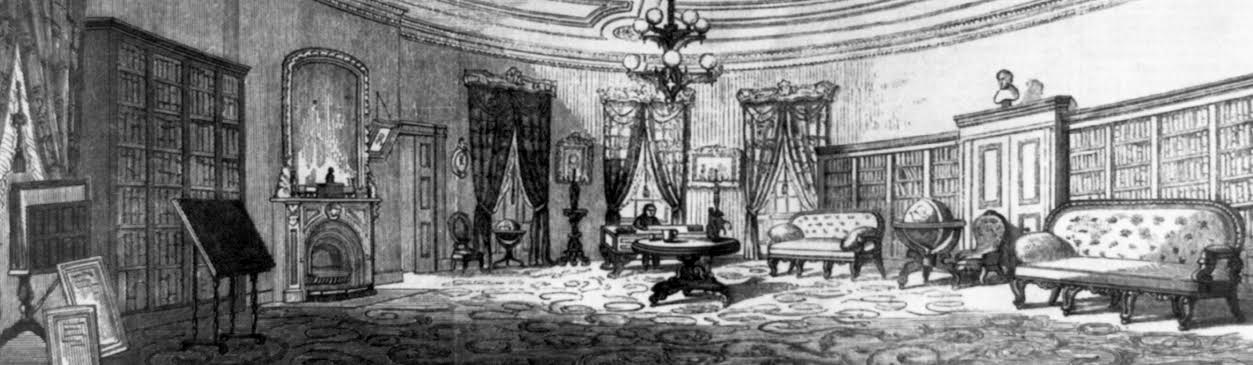
Sunday night (Monday morning in Australia), I appeared on ABC’s The Book Show to talk about authors’ libraries with Anita Barraud. If you want to listen to the interview, click here. And if you’ve found this site through the ABC, check out my original story in the Boston Globe, my supplemental blog post on Markson and Melville, and an NPR segment on it.
Author: Craig Fehrman
Craig Fehrman is the author of Author in Chief (February 11, 2020). Find out more at his website http://craigfehrman.com.
The College-Exploitation Machine
Dustin Sinclair, an old college roommate and current good friend, and I co-wrote an op ed in the Lexington Herald-Leader on higher education’s growing costs and shrinking access. This is an enormously complex issue, of course, but we tried to highlight the overlooked influence of employers’ hiring expectations. Education experts seem to forget that, increasingly, businesses require college degrees for jobs where that just doesn’t make sense. Dustin and I argue that it’s time for employers to stop fixating on the four-year degree.
Marion Maneker slices up the WSJ story on ebooks and literary fiction
This Wall Street Journal story — on the way the ebook economy is “pinching” literary fiction more than other segments of publishing — has been getting predictable amounts of attention. Nevermind that it’s complete nonsense. Marion Maneker, who may be the sharpest writer on the business side of books, explains why in this post at BNET. Before Slate folded the site, Maneker wrote the “Goodnight, Gutenberg” blog at The Big Money. The “Gutenberg” archives are worth reading, if you didn’t catch them live. And Maneker’s new blog at BNET is as well.
Talking David Markson on NPR’s All Things Considered
[NPR]
On this weekend’s All Things Considered, I got a chance to talk with Guy Raz about David Markson and the surprising fate of many authors’ libraries. The segment was based on my story for the Boston Globe‘s “Ideas” section (see also this blog post), and NPR did a great job expanding on it — they even interviewed Annecy Liddell, the recent college grad who discovered one of Markson’s books and kick-started this whole crazy process.
One more thing: “connectable” is in fact a word. Not a common one — certainly not an elegant one — but a word nonetheless.
Jimmy Carter’s Second, Polished Draft of History
Two days before Jimmy Carter’s inauguration, Art Buchwald used his “Capitol Punishment” column to offer some advice to the incoming administration. “The first thing to do when you get to Washington,” Buchwald wrote, “is find a literary agent. The second thing is to buy a four-year diary and fill it every day with vignettes about the mistakes made by the people you work with in the administration. It is never too early to start writing your book.”
I can’t think of a better gloss on Jimmy Carter’s literary career — a career that now extends to White House Diary, his 26th book, which I review in Sunday’s San Francisco Chronicle. The book’s other reviews, as political book reviews so often do, focus on checking Carter against the historical record and drumming up his juicy details. There’s nothing wrong with this approach, except that it doesn’t really work with White House Diary because the book includes so little that’s new. The two stories whirling around the political news cycle — Carter’s belief that the Iran hostages cost him the 1980 election and that Edward Kennedy sabotaged his health care proposal — both appeared 28 years ago in Carter’s Keeping Faith, albeit in slightly milder form. That’s why, in my review, I tried to talk about White House Diary as a diary — as a specific kind of book that readers approach with specific expectations and specific standards. From this perspective, White House Diary is an almost total failure. I never thought I’d have a reason to recommend Keeping Faith (still in print, by the way, as is Carter’s much better Why Not the Best?). But I submit that it’s a more coherent and less manipulative picture of Carter’s presidency.
I do want to expand on two statements in my review. First, I talk about the the growing genre of presidential diaries. While Reagan and Carter were the only twentieth-century presidents to keep consistent diaries, just about all of them dabbled in it. (Many of them also saw their diaries subpoenaed, which explains why recent presidents have kept quiet about their diaries or opted for an alternative — Bill Clinton’s conversations with Taylor Branch, for example.) Truman kept a sporadic diary, as did Eisenhower. Nixon kept a daily diary for 20 months and quotes from it about 150 times in RN: The Memoirs of Richard Nixon. For a while, George H. W. Bush kept a diary as vice president, and he tried (and lapsed) again as president. (Bush was more faithful as a young man in China.) There’s also the related genre of “presidential daily diaries,” the official, obscenely detailed logs of a president’s activity. Carter’s daily diaries often start with this: “5:00: The President received a wake up call from the White House signal board operator.” These documents include entries for the briefest of meetings, every single photo op, even one-minute phone calls. You can browse Carter’s here, along with Gerald Ford’s, Lyndon Johnson’s, and many more presidents on their libraries’ websites. (I won’t get into the pre-Truman diaries, but here’s one fun example: the Massachusetts Historical Society updates a Twitter account with entries from John Quincy Adams’s diaries.)
The second thing I want to touch on is my comparison of Reagan’s and Carter’s diaries. None of the afore-linked reviews make this connection, but I hope my review shows how important it is. (It’s also important to compare a president’s diary with his memoirs. In 2004, plenty of The Reagan Diaries‘ reviewers chuckled at its spelling; as Reagan explains in An American Life, though, he developed a loose and unorthodox system while delivering multiple daily speeches for General Electric. “Of course, this hasn’t done much for my spelling,” in Reagan’s example, becomes “cours ths hsnt don much my splng.”) Reagan’s diary was a huge best-seller in 2004, and I think this comparison suggests one reason Carter resurrected his diary. But the Carter reviewers’ omission of Reagan as a counter-example illustrates something else: how, despite all the noise about their value as history — and this noise normally tops out right after a leak of the president’s megamillion dollar advance — how shockingly disposable these books can be.
 Craig Fehrman