[Los Angeles Times]
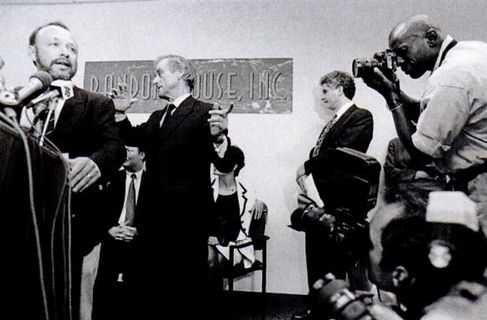 In today’s Los Angeles Times, I’ve got an Op Ed on the media furor over O: A Presidential Novel. While the anonymous title doesn’t drop ’til next week, there’s already been tons of speculation about its author. (My guess? If the person “has been in the room with Barack Obama,” why not Tareq and Machael Salahi?) But there’s something telling about this speculation. As I write in my Op Ed,
It’s a good example of the insularity and superficiality that defines the Washington media. It’s also an opportunity to reflect on why anyone would bother writing or reading a novel in the first place.
The O uproar, of course, is also reminiscent of the one surrounding Joe Klein’s Primary Colors. In an August 1995 essay on the decline of the Washington novel, Terry Teachout noted that “addicts with an eye on 1996 have to look forward, among other things, to a Clinton ’92 roman a clef by an allegedly anonymous author said to be a big-time political reporter.” Already, then, Primary Colors was in the air — and the authorial speculation increased as the galley copies went out. In 1996, though, the media waited until the book was out (and until they knew it was decent) before they started wasting other people’s time with this speculation. And that’s the difference.
Now, this isn’t to say that the Primary Colors affair was a positive one, and I’ll expand on a few of the more fascinating low points below. It might not be clear from my Op Ed, but Klein was responsible for plenty of those low points. His excuse for taking five months to fess up was that he owed the silence to his publisher. But several contemporary reports suggest that, by April, Random House wanted Klein to come out because it would create another round of publicity. (The publisher even entered negotiations with People and the Today show.) There’s also the fact that Klein continued reporting on Clinton — and that they had long enjoyed an on-again, off-again relationship. (In 1994, Esquire published a two-year old memo addressed to Clinton: “Joe Klein: He is disappointed in you. As always. He thinks you’re not being tough enough on the real problems. Of course, much of this is a result of Joe’s obvious belief that you are the last best hope of the planet Earth.”)
In both instances, Klein tried to have it both ways. And this, along with some sanctimony — the picture above comes from his confessional press conference, where he invoked Henry Adams several times — seems to have been his main error. Even here, though, Klein was easily outdone by the rest of the media, and more on them in a second. But first, a few more examples of Primary Colors‘ popularity. Klein got $1.5 million for the book’s paperback rights, another million plus for international rights (19 countries!), and another million for film rights. A very conservative estimate of his total take would run to $6 or $7 million. It’s no surprise that, almost immediately, phrases like “the Russian version of Primary Colors” started cropping up (here, in the NYT), or that politicians started saying things like “Now the biggest parlor game in Washington, besides trying to figure out who wrote Primary Colors, is trying to decide whether or not President Clinton wants a real balanced-budget agreement” (here, Bob Dole).
Two more tangents. First, remember that Shakespeare scholar with the computer? Turns out it was Donald Foster. Foster correctly fingered Klein, but, a few years later, saw his name-making claim — that Shakespeare had written 1612 poem, A Funerall Elegye — debunked. Also a few years later, the Primary Colors lawsuit finally wrapped up. In 2005, a New York judge ruled against a woman seeking $100 million because she claimed to be the basis for a librarian who sleeps with Klein’s Clinton stand-in early in the novel. One can understand her frustrations, but one can also wonder why, if they were genuine, she continued to associate her name with the novel through a lawsuit, then an appeal. Either way, the decision itself contains some fascinating stuff like: “Plaintiff argues that Primary Colors was not a work of fiction because it is considered a roman a clef.”
This post is now longer than my Op Ed, so let’s close with the media — and with the Washington Post investigation that finally proved Klein’s authorship. The story, which ran on the paper’s front page on July 17, 1996, was penned by David Streitfeld. Now, I’ve praised Streitfeld on this blog before, but this story was and is nonsense. First, and most obvious, the novel had been out for five months by this point. Second, the paper sank some serious resources into the story. Streitfeld or someone else at the Post (according to Primary Colors‘ paperback afterword) stole Klein’s notebook. This gave them — or rather, the expert they hired — something to compare to the ten words of Klein’s handwriting contained in an early manuscript of Primary Colors, a manuscript the Post purchased from a Washington rare books dealer for several hundred dollars. Third, Streitfeld corroborated the handwriting match with reporting like this:
Klein has been living well, if not exactly lavishly, in the past year. In July 1995, a few months after Random House bought Primary Colors, he bought a $630,000 house in Pelham, a New York suburb, real estate records show.
He took on a $ 310,000 mortgage, suggesting that he plunked down $ 320,000 in cash. Three cars are registered in his name in New York — an Acura and two Fords. The newest is two years old. The gossip at Pelham dinner parties this spring was that Klein’s daughter was boasting at school, “My daddy is rich.”
This strikes me, frankly, as disgusting. It also underscores what must have been a major motivation throughout this whole mess: jealousy.


 Craig Fehrman