[Bookslut]
For my review of Dave Zirin’s new A People’s History of Sports in the United States, head over to Bookslut.

[Bookslut]
For my review of Dave Zirin’s new A People’s History of Sports in the United States, head over to Bookslut.
[Gelf]
Chuck Klosterman’s first book, Fargo Rock City, is really, really good. I know a lot of people share this opinion—most famously, David Byrne—and it’s a book I enjoy both musically (having long loved Guns ‘n Roses) and geographically (having recently left Indiana).
Klosterman’s more recent stuff seems to polarize readers, especially when those readers are other writers. In a new essay for Gelf, though, I try to evaluate his turn to sportswriting and fiction in a somewhat sober fashion. If you’re a fan of Chuck, or just curious about his new novel and new direction, check out “The Cure for the Common Cusack.”
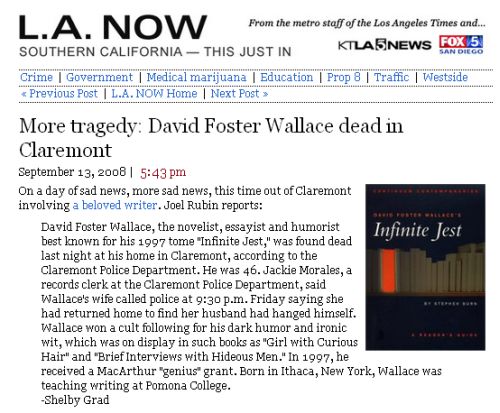
The Internet is alight with the news of David Foster Wallace’s suicide. This is hitting me hard, not only because of Wallace’s youth, talent, and unfinished business, but because of my sense that he was not the type of artist who did this. In his writing, and especially in his magazine writing, I always found an authenticity and decency and all-around avoidance of self-tortured preening. I’m not saying we can (or should) spot suicidal hints in an artist’s work, but I am saying Wallace connected to real emotions and real concerns in a way that separated him from many of his pomo peers.
This doesn’t feel like the time to worry about who broke the news, but I found out via the LA Times‘ blog. In choosing an image to accompany the story, the reporter posted the wrong book cover—not of Wallace’s opus, Infinite Jest, but of Stephen Burn’s David Foster Wallace’s Infinite Jest: A Reader’s Guide, a short volume in the “Continuum Contemporaries” series.
The Times‘ unintentional slip feels like a fitting sort of tribute—with possible implications for Wallace’s style and audience, his relationship to academia, and even the state of fiction today—but I don’t feel like parsing it. I just feel sad.
[Gelf]
I first heard about professional videogaming in 2007 — via this article, actually — but haven’t given it much thought since. It might be fun to watch a Kentucky-bred, corn-fed NASCAR fan argue with a Gamestop employee about the true meaning of “athlete,” but the idea of watching videogames doesn’t sound appealing.
Recently, though, I interviewed Michael Kane about his new book Game Boys: Professional Videogaming’s Rise from the Basement to the Big Time , which tries to explain the appeal of team-based games like Counter-Strike. You can find the interview, along with some interesting anecdotes on the reading habits of videogamers, at Gelf.
 Craig Fehrman