Reprinting Reagan

I’m switching gears to work on some long-term projects, which may mean fewer story links and deleted scenes. That said, I want to keep writing regularly, so the plan is to do more short, standalone posts. They might be a little dated, but I hope they’ll also be interesting. Expect lots of presidents, publishing history, and weird-slash-strangely familiar stuff from old media sources.

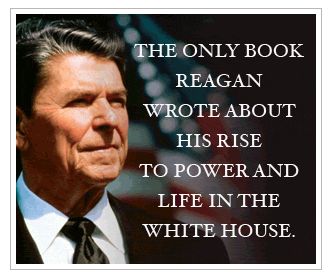
So, in that spirit: while researching Jack Cashill’s crackpot theories about the real author of Barack Obama’s books, I came across the following web ad:

It seems that, in honor of Reagan’s birth centennial, Simon & Schuster has decided to reissue An American Life, his presidential memoir, in hardcover. Immediately after his death, in 2004, the publisher also rushed out a fresh batch of 10,000 copies. But this is something new. First, there’s the targeted online ad campaign. (I saw this one here.) Then there’s the brand new online book trailer. “Thousands of books have been written about Ronald Reagan’s presidency,” the trailer opens. “Only one in his own words.”

Most interesting of all, though, is Simon & Schuster’s release of a new “enhanced ebook” that combines Reagan’s text with contemporary videos. It’s a smart and relatively easy move since Simon & Schuster is now owned by the CBS Corporation, which of course owns all the news footage one would ever need. But political books often end up in these sorts of multimedia experiments. Rick Perlstein’s Nixonland was Simon & Schuster’s first “enhanced ebook,” with 27 videos interpolated into the almost 900 pages of text. Sarah Palin and Ted Kennedy’s plain old ebooks became important data points in the publishing industry’s attempts to delay ebooks in order to goose hardcover sales. And way back in 1990, for its original release, Reagan’s An American Life became the first presidential memoir audio book.

In a forthcoming academic article, I’ve got a lot more to say about Reagan’s career as an author, which is much more interesting — and much more rewarding — than you might initially think. I’ll post a .pdf of it when the journal issue comes out. Let’s hope that happens in 2011, so we can keep riding the birth centennial wave.

James Kloppenberg vs. Jack Cashill

[Washington Post]

In Sunday’s Washington Post, I’ve got a long review of two books about the books of Barack Obama — James Kloppenberg’s Reading Obama, which reverse-engineers the ideas in Dreams from My Father and The Audacity of Hope, and Jack Cashill’s Deconstructing Obama, which advances his theory that Bill Ayers actually wrote Dreams. Kloppenberg’s book is pretty good. Cashill’s is pretty grotesque, and, by the end of my review, I suggest that its mere existence says some troubling things about the modern publishing industry.

Despite all that, I still don’t think my review comes down hard enough on Cashill. I say he “bends and invents evidence to fit his theories,” but lacked the space to really prove it. So let me do that here, first with a more developed example, then with a few quick hitters. I’m not trying to be pedantic, and I’m not trying to be political. But I am trying to stand up for some common standards of fact and argument and discourse — even if Cashill, and his publisher, Simon & Schuster, do not.

One thing to admire about Cashill is his comprehensiveness. It’s not enough for Ayers to have written Dreams. For Cashill, he must also have written parts of Audacity and even Obama’s famous 2002 speech against the Iraq war. I’ll run down Cashill’s reasoning on this latter point, to which he devotes an entire chapter, and put my counterarguments in bold parentheses. Cashill begins by describing Obama’s speech as cowardly and calculating. (In reality, Obama talked frankly about a “dumb war” and a “rash war.”) Cashill pauses to note that Obama praised his grandfather’s service in World War II — and that he would later assign this to an apocryphal uncle in 2008. (Here’s Cashill frantically defending Sarah Palin’s “Korea” gaffe.) Cashill also cherrypicks statistics in order to dispute Obama’s description of a struggling economy. (Obama mentions “a stock market that has just gone through the worst month [September] since the Great Depression”; Cashill counters that “the Dow Jones would gain more than 10 percent in that very October of Obama’s discontent.” Which statistic better captures the reality?) But Cashill soon gets to the business at hand: “Despite Obama’s claims to unique authorship,” he writes, “one senses a radical contribution to the speech.” What catches Cashill’s attention? The fact that Obama singles out the Defense Department’s Richard Perle and Paul Wolfowitz for censure — “two names in common parlance only on the hard left,” Cashill writes. (A year later, David Brooks devoted an entire column to the idea that everyone was giving Perle and Wolfowitz too much credit.) Cashill also uses the mention of Perle and Wolfowitz to implicate Ayers, who attended Obama’s speech and whom Cashill believes to be virulently antisemitic. At the end of the chapter, Cashill unveils his masterstroke: Obama later told a reporter that “it was a hard speech to give. And it was just, well, a well-constructed speech” — and in this phrasing, Cashill argues, Obama lets slip that the text “had been handed to him” by none other than Bill Ayers.

Again, this kind of nonsense saturates Cashill’s book. Let’s switch to bullet points for some of my favorite examples.

  • Cashill keys onto the word “ballast,” which Obama and Ayers both use in their memoirs. When the word is “flat-out misused” in Audacity — Obama describes religion as “a ballast against the buffeting winds of today’s headlines” — Cashill sees it as proof that Ayers has been replaced by Obama’s speechwriters. Throughout his book, Cashill makes much of Ayers’s nautical background, writing here that “no one in the know uses the phrase ‘ballast against’ in reference to a ship.” Perhaps not, but plenty of people use it in reference to “a balloon or airship” (the OED’s second definition), including Obama here.
  • For someone whose arguments depend in large part on his literary sensibility, Cashill writes quite poorly. In particular, he struggles with pacing — or, if you want to be cynical, with filling up enough pages to merit a book. At one point, Cashill spends a page on “an eye-popping documentary” about Africa, which leads to another page on his seven-year-old spat with Thomas Frank — and all this by way of introducing the reader to Sarah Palin. Even more egregious are Cashill’s frequent and lengthy asides about the editors who won’t publish him, the allies who don’t have his back, and all the usual enemies in modern conservatism’s paranoid style.
  • Speaking of those enemies: Cashill attacks a Politico reporter for taking “as gospel” David Axelrod’s defense that Obama and Ayer’s kids “attend the same school,” but never mentions that Axelrod was responding to that same reporter’s 1800-word exposé on Obama’s early relationship with Ayers — an exposé Cashill cribs from later in his book.
  • And speaking of comprehensive: I haven’t even mentioned Cashill’s most absurd arguments, such as the one that “Pop,” Obama’s youthful poem, is both by and about Frank Marshall Davis — and that the poem’s “amber stain” may allude to an act of oral sex between Obama and Davis. I could also mention that, earlier in his book, Cashill spends several pages demonstrating that Obama’s early writing sucks (it does), which makes the “Pop” theory seem superfluous. But I think I’ll just let its insanity resonate all by itself.

I also wish I had had more space to talk about Kloppenberg’s book. While Cashill would surely seize on to the New York Times report that Kloppenberg’s work has received “prolonged applause” from his fellow professors, Kloppenberg actually defends Obama from both the right and the left. (For example, Kloppenberg chastens those professors who want to see Obama’s Christianity as political calculation: “Like the overwhelming majority of Americans outside the small subculture of academic life, Obama locates the foundation of his own moral principles in his religious faith.”) Kloppenberg also outworks his conservative counterpart. Where Cashill worries about (and actually line edits) Obama’s youthful essay on nuclear protesters in the Sundial, a student publication at Columbia, Kloppenberg combines his discussion of that essay with an interview with a professor who remembered Obama writing a paper that advocated for a moderate form of nuclear nonproliferation. (Kloppenberg also digs up another Obama Sundial essay that Cashill missed.)

Still, the story here is Deconstructing Obama. Cashill’s opus should remind us that the book industry, for all its virtues, still has a lower filter than other media. Publishing doesn’t fact-check like magazines. It doesn’t possess a newsroom’s institutional culture. In fact, in each and every book contract, it puts the burden of truth (and the threat of lawsuits) on its authors. Publishers sell this as the result of limited resources, but it also means anything that sells is fit to print. Even if it’s as grotesquely padded, delusionally argued, and comprehensively paranoid as Deconstructing Obama.

A Review of Scott Brown’s Against All Odds

[Boston Globe]

Here’s one way to chart the improbable, accelerated rise of Scott Brown: in his new memoir, Against All Odds, Brown remembers laying in bed, thinking he could win Ted Kennedy’s Senate seat if his campaign managed to raise $1,000,000. Well, there’s a good chance Brown’s book deal topped that number by itself. I’ve got a review of Against All Odds in today’s Boston Globe, and I call it “an incredible life story, told in the most safe and surface-level terms possible.” The book doesn’t talk much about Brown’s politics, but he’s shown terrific political savvy in rolling it out. Did you know Senator Rand Paul also had a book come out this week? Neither did anyone else.

As I mentioned in my review, some of the weirdest moments in Brown’s book come when he adopts a bizarrely literary tone. Here’s my favorite example: “The air was hot, that sticky, humid July heat, where the sky turns thick and white and presses back down upon you until each breath seems liquid, like sucking pool water into your lungs.” I’m not sure whether this stems from Brown’s desire to dress up what is essentially a personal autobiography, or from his (and other politicians’) anxiety about writing a memoir in a post-Obama age. Another weird quality of Against All Odds is Brown’s constant hedging; every factual statement gets a “probably” or “I remember.” In my favorite example of this, Brown’s reasons seem pretty clear: “Behind Al Di Santo’s house,” Brown writes of another one of his stepfathers, “was a sheer rock wall that I scrambled up and down, rocks that were probably the legacy of millions of years of glaciers, advancing and retreating across the Massachusetts landscape.”

They Wouldn’t Dare

Next week, I’m reviewing Massachusetts Senator Scott Brown’s new memoir, Against All Odds. But this week I’m researching former Massachusetts Senator John F. Kennedy’s political megahit, Profiles in Courage, and I just came across a great essay in the December 1961 issue of Harper’s. In “The Cult of Personality Comes to the White House,” William G. Carleton spends most of his energy diagnosing Kennedy’s “personalization of the Presidency” — a trick used by just about every politician today, including Scott Brown. But Carleton also includes the following riff on America’s shared fear of close elections, a riff that, today, seems to come not just from another era but another nation:

Unlike the nineteenth century, most Presidential elections in the twentieth century have been landslides, generally in both the popular vote and the Electoral College. Only three, 1916, 1948, and 1960, have been close — and the election of 1960 would probably alsohave been decisive for Kennedy but for the strength of the “No Popery” sentiment. It is actually difficult to have a close election today because of our continuing crisis psychology and the way the national media both reflect and help mold a national mood. (It is a curious fact that in a Republican year the major newspapers and magazines mirror the attitudes of their owners and publishers while in a Democratic year they reflect the views of their working reporters, correspondents, commentators, and columnists.) The nation now expects and wants a decisive Presidential election; it feels uncomfortable when the outcome is close. Because of our fear of an uncertain interregnum in time of peril and our self-consciousness in the face of a watching world, a contested Presidential election would be intolerable. For these reasons the Republicans in 1960 did not dare carry out the threat of recounts in the close states; similarly the Dixiecrats quailed at the prospect of actually exploiting the potential deadlock in the Electoral College, which they had so long awaited.

Everybody Loves Anonymous

[Los Angeles Times]

In today’s Los Angeles Times, I’ve got an Op Ed on the media furor over O: A Presidential Novel. While the anonymous title doesn’t drop ’til next week, there’s already been tons of speculation about its author. (My guess? If the person “has been in the room with Barack Obama,” why not Tareq and Machael Salahi?) But there’s something telling about this speculation. As I write in my Op Ed,

It’s a good example of the insularity and superficiality that defines the Washington media. It’s also an opportunity to reflect on why anyone would bother writing or reading a novel in the first place.

The O uproar, of course, is also reminiscent of the one surrounding Joe Klein’s Primary Colors. In an August 1995 essay on the decline of the Washington novel, Terry Teachout noted that “addicts with an eye on 1996 have to look forward, among other things, to a Clinton ’92 roman a clef by an allegedly anonymous author said to be a big-time political reporter.” Already, then, Primary Colors was in the air — and the authorial speculation increased as the galley copies went out. In 1996, though, the media waited until the book was out (and until they knew it was decent) before they started wasting other people’s time with this speculation. And that’s the difference.

Now, this isn’t to say that the Primary Colors affair was a positive one, and I’ll expand on a few of the more fascinating low points below. It might not be clear from my Op Ed, but Klein was responsible for plenty of those low points. His excuse for taking five months to fess up was that he owed the silence to his publisher. But several contemporary reports suggest that, by April, Random House wanted Klein to come out because it would create another round of publicity. (The publisher even entered negotiations with People and the Today show.) There’s also the fact that Klein continued reporting on Clinton — and that they had long enjoyed an on-again, off-again relationship. (In 1994, Esquire published a two-year old memo addressed to Clinton: “Joe Klein: He is disappointed in you. As always. He thinks you’re not being tough enough on the real problems. Of course, much of this is a result of Joe’s obvious belief that you are the last best hope of the planet Earth.”)

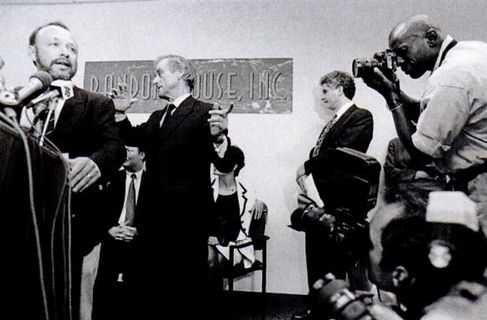
In both instances, Klein tried to have it both ways. And this,  along with some sanctimony — the picture above comes from his confessional press conference, where he invoked Henry Adams several times — seems to have been his main error. Even here, though, Klein was easily outdone by the rest of the media, and more on them in a second. But first, a few more examples of Primary Colors‘ popularity. Klein got $1.5 million for the book’s paperback rights, another million plus for international rights (19 countries!), and another million for film rights. A very conservative estimate of his total take would run to $6 or $7 million. It’s no surprise that, almost immediately, phrases like “the Russian version of Primary Colors” started cropping up (here, in the NYT), or that politicians started saying things like “Now the biggest parlor game in Washington, besides trying to figure out who wrote Primary Colors, is trying to decide whether or not President Clinton wants a real balanced-budget agreement” (here, Bob Dole).

Two more tangents. First, remember that Shakespeare scholar with the computer? Turns out it was Donald Foster. Foster correctly fingered Klein, but, a few years later, saw his name-making claim — that Shakespeare had written 1612 poem, A Funerall Elegyedebunked. Also a few years later, the Primary Colors lawsuit finally wrapped up. In 2005, a New York judge ruled against a woman seeking $100 million because she claimed to be the basis for a librarian who sleeps with Klein’s Clinton stand-in early in the novel. One can understand her frustrations, but one can also wonder why, if they were genuine, she continued to associate her name with the novel through a lawsuit, then an appeal. Either way, the decision itself contains some fascinating stuff like: “Plaintiff argues that Primary Colors was not a work of fiction because it is considered a roman a clef.”

This post is now longer than my Op Ed, so let’s close with the media — and with the Washington Post investigation that finally proved Klein’s authorship. The story, which ran on the paper’s front page on July 17, 1996, was penned by David Streitfeld. Now, I’ve praised Streitfeld on this blog before, but this story was and is nonsense. First, and most obvious, the novel had been out for five months by this point. Second, the paper sank some serious resources into the story. Streitfeld or someone else at the Post (according to Primary Colors‘ paperback afterword) stole Klein’s notebook. This gave them — or rather, the expert they hired — something to compare to the ten words of Klein’s handwriting contained in an early manuscript of Primary Colors, a manuscript the Post purchased from a Washington rare books dealer for several hundred dollars. Third, Streitfeld corroborated the handwriting match with reporting like this:

Klein has been living well, if not exactly lavishly, in the past year. In July 1995, a few months after Random House bought Primary Colors, he bought a $630,000 house in Pelham, a New York suburb, real estate records show.

He took on a $ 310,000 mortgage, suggesting that he plunked down $ 320,000 in cash. Three cars are registered in his name in New York — an Acura and two Fords. The newest is two years old. The gossip at Pelham dinner parties this spring was that Klein’s daughter was boasting at school, “My daddy is rich.”

This strikes me, frankly, as disgusting. It also underscores what must have been a major motivation throughout this whole mess: jealousy.