e-leaked?

[Washington Post]

At the Washington Post’s Political Bookworm, I’ve got a blog post explaining how the publisher of Jimmy Carter’s White House Diary accidentally violated its own publicity embargo. I also run down the history of  this sort of thing — it involves both Richard Nixon and Pinkerton guards — but the newsy take away is this: the first 50 pages of Carter’s Diary, which comes out next week, are available right now on Google Books. A diary that’s three decades old will offer a different appeal than a hot new memoir, but there’s still some juicy details. Let’s start with this one: Carter says he got the idea to keep a diary from Nixon.

(If you’re in the mood for more on political book culture, check out this New York Times Book Review essay on the history of first lady memoirs and this American Prospect essay on the history of political ghostwriting.)

What Is a Ghostwriter?

[Los Angeles Times]

In today’s Los Angeles Times, I’ve got an op-ed that is, among other things, a quasi-defense of political ghostwriting. I start with an anecdote about Eleanor Roosevelt and her first lady memoir This I Remember (1949), and one point I want to make is that these issues have been with us for a while. After all, Bess Truman, Eleanor’s successor, told a reporter in 1952 that “everyone else connected with Washington has written a book. I am certainly not going to compound the felony!”

A few weeks back, I wrote a separate essay for The American Prospect arguing that most readers, historically, haven’t cared about ghostwriting. Even today, when a political book’s behind-the-scenes details get served up as news, ghostwriters matter only as an extension of their clients. (Sarah Palin’s ghostwriter was widely criticized, but who can name Joe Biden’s?) Still, there are a few people—usually professional writers—who get worked up about ghostwriting. The Times op-ed is aimed at them; I think it also works nicely as a counterpoint to my Prospect essay.

One other thing: in addition to her 20-plus books, Eleanor Roosevelt also wrote for magazines and newspapers. I highly recommend her “My Day” column, and, thanks to The Eleanor Roosevelt Papers Project, you can read them all online. Just on the subject of This I Remember, you’ll find columns on Humphrey Bogart asking for an autographed copy and on Eleanor’s writing process (and note there her casual, authorial repetition of “I”). But one column in particular resonates with both the op-ed and my recent New York Times essay on the history of the first lady memoir. On November 11, 1949, Eleanor writes:

I have just been told that though the manuscript of my book as it appeared in McCall’s did not make a mistake, there is one in the book which I hope can be corrected in future editions. In some way a slip was made in referring to Mrs. Mary McLeod Bethune as “the late” Mrs. Bethune. Since she is now trying to raise large sums for her college and is most active, I am sure I could not have overlooked such a mistake. But one never can tell what one’s eyes will do when one had read a manuscript many, many times. I only wish here to apologize to her and assure her that it will be changed in the future editions.

“Because there isn’t a woman in the country who isn’t perishing to know what it’s really like to be the wife of an American president today”

[New York Times]

In this Sunday’s New York Times Book Review, I’ve got an essay on the history of the first lady memoir. (It’s already online.) Laura Bush’s Spoken from the Heart gives us 12 such books,[1] and a few are genuinely good. I single out Lady Bird Johnson’s White House Diary for praise, but even the more prosaic examples are worth our time. In 2003, a professor named Robert Watson compiled a list of first lady biographies. Watson’s top five are no surprise: Jacqueline Kennedy (who’s been the subject of 37 biographical books), Eleanor Roosevelt (35), Hillary Rodham Clinton (27), Mary Todd Lincoln (19), Dolley Madison (16), and Abigail Adams (13). But 17 first ladies had received zero or one biographies. And while that ratio is improving—see the recent biographies of Helen Taft and Louisa Adams, both mentioned in my essay—I find it brave, and even inspiring, that these women were writing their own stories when no one else would.

One way to measure the impact of Lady Bird’s Diary—and I wasn’t able to get into this in the essay—is to look at when the first lady memoir became a distinct genre with its own history. Publishers loved to market early first lady memoirs as disposable women’s lit. (While doing the research, I posted an example of this; this post’s title, taken from a White House Diary ad, is another.) Journalists and reviewers didn’t help things. The NYTBR review of Edith Wilson’s memoir that I quote in the essay erroneously called it the first first lady memoir. At least a reader wrote in with a stern correction.

The craziest example of this came in the coverage of Lady Bird’s Diary, which kept describing it as the first such book “since the memoirs of Abigail Adams.” I’m not sure what’s worse: that this ignores several first lady books or that it invents a historical document. I emailed Edith Gelles, author of the excellent Abigail Adams: A Writing Life, and asked for her help: “Abigail’s only ‘journal,'” Gelles confirmed, “was a brief diary that she kept of her journey to England.” So what are “the memoirs of Abigail Adams”? The best theory I’ve got is that a frazzled journalist scanned the title (but not the contents) of the 1840 Letters of Mrs. Adams, The Wife of John Adams. With An Introductory Memoir By Her Grandson, Charles Francis Adams. The “memoir” is a biographical sketch written by Charles—similar in format to what he did for John Adams’s oeuvre a few years later. Nevertheless, someone said something about Abigail Adams and memoirs. A few repetitions and we ended up with Abigail Adams’s phantom autobiography.

Contrast this with today: as First Lady, Laura Bush could quote from Lady Bird’s Diary; now, as a first lady memoirist, she can explain how she “wanted to give people a sense of what life is like in the White House, even in mundane ways. . . . [That wasn’t] really a part of the other First Ladies’ memoirs that I read. ” (Of course, this comes from her cover story in the latest Ladies’ Home Journal; some things never change.) You won’t find anything like Laura’s awareness of writing in a tradition until after Lady Bird. Even though Eleanor Roosevelt wrote more than 20 books, for example, the coverage of A White House Diary never mentioned her as an antecedent.

That’s one reason I describe Eleanor as an “outlier” in my essay. But Eleanor was also an outlier in her grasp of the first lady tradition. In her syndicated newspaper column for Januray 25, 1939, she writes:

I went to bed fairly early last night and read the last installment of Mrs. Woodrow Wilson’s memoirs. I find the editor’s notes, which skip over what you feel must be interesting reading, a little disconcerting. I suppose this is done to keep more of the interest for the book, which will appear later.

————–

[1] Books aren’t the only form for memoir, of course, and several first ladies wrote autobiographical essays. I’ll mention Grace Coolidge’s example—to avoid confusion as much as anything else since, in 1993, her series of essays for American Magazine (along with some unpublished material) was issued as Grace Coolidge: An Autobiography.

Keeping Pace

This weekend, I’ve got a couple of new essays related to my presidents-and-their-books project coming out. With them finished, I’ve been catching up on some reading, and I can now highly recommend Political Memoir: Essays on the Politics of Memory (1994), a collection of essays edited by George Egerton.

The book originated at an academic conference, and its contents range from India to Canada, from military lifers to American presidents. The best chapter tells the story behind Harry Truman’s memoirs—in fact, it’s written by Francis Heller, who served as Truman’s last (and best) hope in that book’s long succession of ghostwriters. (You can read most of Heller’s essay, which is breezy and accessible, here.)

But I was also captivated by another essay in the collection: Stephen Ambrose’s “Nixon and His Memoirs.”  Ambrose starts by suggesting that Nixon, as an author, “believed that the past should serve the needs of the present.” Next, he explains Nixon’s motivations: “the contempt he feels towards those who report on his activities and actions, and the contempt he feels for the public at large.” Finally, in my favorite sentence, Ambrose observes that “[Nixon] continues to produce books and articles at a pace professional writers cannot equal.”

It’s hard to argue with any of this, but the best context for enjoying these quotations is Ambrose’s own authorial career. After all, by 1994, he was already implementing his Fordist approach to writing history—though we would need to wait a few years for the plagiarism scandals that he (and Doris Kearns Goodwin) somehow managed to shrug off. Still, I’d say we can describe Ambrose’s reaction to the scandal as downright Nixonian: a selective tweaking of the facts; a stiff arm to the press; and, through it all, a pace that most professional historians could not equal.

I realize that I never linked to Richard Rayner’s incredible exposé of Ambrose’s lies about his relationship to Dwight Eisenhower, which ran in a recent issue of The New Yorker. Rayner debunks both Ambrose’s origin story (that Eisenhower called on him to write his biography) and his account of the “hundreds and hundreds of hours” they spent together. Seven of the nine interviews cited in the footnotes to Ambrose’s The Supreme Commander (1970), for example, simply could not have happened. Is it any wonder that, in contrast to, say, Heller’s essay in Political Memoir, which is scrupulously sourced, Ambrose’s includes only two footnotes—each to the first occurrence of a Nixon book?

Great Moments in Advertorial History

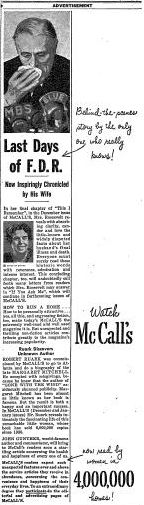
I’m wrapping up an essay on the history of the first lady memoir (and wishing I had about a million more words for this topic), but I had to stop and share this ad. It ran in the November 15, 1949 edition of the New York Times (along with a bunch of other newspapers), and it champions a forthcoming issue of McCall’s.

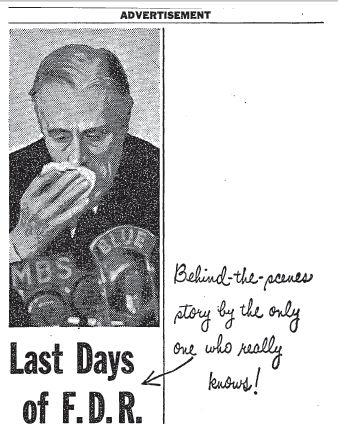
The ad is visually arresting—not only in its own terms, but also in its similarity to the slippery Gawker-like campaigns you see all over the web today.

Here’s a detail of the top:

Here’s the first paragraph of the ad:

In her final chapter of “This I Remember,” in the December issue of McCALL’S, Mrs. Roosevelt reveals with absorbing clarity, candor and love the little-known and widely disputed facts about her husband’s final illness and death. Everyone must surely read these historic words with reverence, admiration and intense interest.

Here’s a description of the magazine more generally (ellipses in the original):

HOW TO RUN A HOME . . . How to be personally attractive . . . yes, all this, and engrossing fiction, too, make today’s McCALL’S the extremely well-read and well used magazine it is.

The last bit of faux-handwritten marginalia is McCall’s slogan from this period: “Now read by women in 4,000,000 homes!”