A review of Jeanne Marie Laskas’s Hidden America

[The Boston Globe]

In Sunday’s Boston Globe I’ve got a review of Jeanne Marie Lasksas’s new book Hidden America: From Coal Miners to Cowboys, an Extraordinary Exploration of the Unseen People Who Make This Country Work. Laskas is one of the best magazine writers in America, and I tried to demonstrate some of the things she does well in my review: getting perfect quotes, showing deep empathy, and always telling stories. I could keep adding to this list — she does a great job stimulating all five senses; she gets so close to her characters that she can turn over whole pages to them and their drama-like dialogue; she does the John McPhee process thing almost as well as the master himself — but I was also struck by something she didn’t do. With one small exception, Laskas avoids making herself a character the way many of today’s flashiest magazine writers choose to.

If you read Harper’s or GQ, you know this trick: the author presents him- or herself as a bumbling (or, less frequently, haughty) narrator who, in the course of the reporting, reaches some kind of flashback-driven epiphany. It’s a great trick, and in a really good essay in Bookforum Gideon Lewis-Kraus traces its origin back to David Foster Wallace. Wallace, Lewis-Kraus writes, was “the great writer-worrier of his time.” And thanks to Wallace’s example, “insofar as there’s a prevailing aesthetic among the best young ‘magazine writers’ of our time, it’s the counterintuitively affirmative: What our nonfiction narrators do now is perform the overcoming of contempt.” You’ll find this performance in essays by John Jeremiah Sullivan, Tom Bissell, Jake Silverstein, George Saunders, Elif Batuman, and Lewis-Kraus himself.

But you won’t find it in the essays of Laskas. She achieves authenticity in a different way: by using her skills as a writer-observer to bring out the best and most human side of her characters. Maybe she does this by necessity — in her chapter on truck drivers, Laskas includes a few bits of memoir that, while well intentioned, fall flat —- but maybe she does it by choice. Laskas’s essays are less rhetorical than those of Wallace et al.; after all, the first-person trick aims partly at seeming authentic and partly at being persuasive. But that lack of rhetoric actually feels pretty refreshing. It’s so easy to imagine a book on “Hidden America” turning into a sermon on “Real America.” But in Laskas’s hands it doesn’t. She does the minute so well that it ends up mattering all by itself.

“A typical case of a small-town boy who betrayed his roots”: David Foster Wallace as a Midwestern writer

[Chicago Reader]

In this week’s Chicago Reader, I’ve got a long review-essay on David Foster Wallace. The review part centers on Every Love Story is a Ghost Story, D. T. Max’s new biography of the author, and the book is just OK. Still, it let me explore Wallace’s relationship to the Midwest  — that’s the essay part — and I hope readers find it intriguing and persuasive.

Now, I could go on about this stuff all day — about how Max’s book corroborates Jonathan Franzen’s essay on Wallace’s inner ugly side; or about how much I’ve come to respect the work of David Lipsky, who consistently got the best quotations out of Wallace (and whose reporting Max relies on relentlessly). But I’ll limit myself to one final aspect of Wallace and the Midwest, and that’s how the region responded to his own writing about it.

The best example comes in the reaction to Wallace’s Harper’s essay on the Illinois State Fair. (You can find a .pdf here.) An editor at the magazine had heard about Wallace moving back to Illinois, and he called the novelist — his U-Haul was still sitting in the drive-way — and pitched him the idea of reporting on the 1993 State Fair. Out of this assignment sprang the nonfiction style that Wallace would later describe to Lipsky as “basically, you know, welcome to my mind for twenty pages. See through my eyes.”

The essay came out the next summer, and it was pure Wallace  — funny, intellectual, empathetic. But most local readers didn’t see it that way. In fact, in a column that ran in Springfield’s State Journal-Register, Toby McDaniel blasted Wallace and his “poison pen.” The State Fair’s organizers were even more outraged, and McDaniel quoted Joe Khayyat, a fair spokesman, at length:

There are so many inaccuracies and inconsistencies in this story, it really doesn’t deserve a response. In fact, the only thing the author seems to be consistent with is his gross misrepresentation of the fair and his use of profanity. It’s a typical case of a small-town boy who betrayed his roots when the big city went to his head.

This defense gets deployed any time a Midwestern author produces non-brochure copy about the Midwest, and Wallace’s essay proves how wrong it is. So too does his response to Khayyat and McDaniel. In the State Journal-Register‘s second story on the affair, which ran a few weeks later, a different reporter, Mike Matulis, asked Wallace for his side. “To be perfectly honest with you, Khayyat’s comments bother me,” Wallace told him. “If the piece came off that way, as some one sneering at the Midwest, then that’s really a deficiency in the piece. It really wasn’t meant to do that.”

For the rest of the story, Wallace praised the State Fair — “There is an intensity about the livestock shows that is the same intensity you see in Lincoln Center” — and the state itself.  “It’s incredibly cheap to live here, and I haven’t heard a car alarm since I moved,” he told Matulis. “I’m not kidding.” Wallace was only getting warmed up: “People smile and say ‘hello,’ I don’t have to lock my house every day and women sometimes walk at night by themselves. And when there is a ghastly murder here, it’s an enormous deal.”

He ended the interview by reaffirming his affection for the Midwest: “My resting pulse rate is lower here. It’s really very nice.” And yet, as late as 2010, the State Journal-Register was still smarting about Wallace’s essay. It’s a colorful and, I think, telling episode about Wallace’s personality and his relationship to readers. But while Max includes some interesting details about the accuracy of Wallace’s nonfiction (“We quietly agreed that his nonfiction was fanciful and his fiction was what you had to look out for,” Wallace’s sister tells him), he never mentions this little State Fair dust up. Nor does he examine the way Wallace’s journalism evolved from “welcome to my mind” to the intensely rhetorical style of his later pieces. These are just a couple examples of why Every Love Story is a Ghost Story is a disappointment, both in terms of its details and its interpretations.

The first in a series on the Bridgeport Bluefish

[Deadspin]

I’ve been spending a lot of time lately at the Ball Park at Harbor Yard — better known as the home of the Bridgeport Bluefish, an independent baseball team. The stadium sits two Metro North stops away from where I live, in Milford, and the plan this summer is to write a series of dispatches on the team and on minor league baseball. The first dispatch is now up at Deadspin.

There’s some fun stuff in there, including a long interview with Tommy John, who became the manager of the Bluefish after Bobby Valentine recommended him. I talked to John right when Valentine was getting the worst of it from Boston fans, and John stood by his friend. “I guess what Pedroia’s saying,” John said, referring to the controversy over Valentine’s comments on Kevin Youkilis, “is that you gotta hold hands and sing Kumbaya. That’s not Bobby. He’s going to stir the pot. If those guys had to play for Dick Williams back in the 1960s, half the team would quit.”

Anyway, it should make for a fun series. I suspect John will reappear at some point, as well.

A review of Matthew Tully’s Searching for Hope

[NUVO]

In this week’s NUVO, an alt weekly in Indianapolis, I’ve got a review of Matthew Tully’s Searching for Hope: Life at a Failing School in the Heart of America. Tully’s a very good columnist at the Indianapolis Star, and while Searching for Hope isn’t great, it’s almost certainly the only book anyone will write about Indy’s inner-city schools for a long time.

The review isn’t online, so I’ll put the full text after the break. One more thing:when I write about Indiana, it’s normally to write about high school basketball. Well, the high school Tully covered just sent its team to regionals. This story didn’t get much attention, but it does line up with the few brief moments of hope in Tully’s book.

Continue reading “A review of Matthew Tully’s Searching for Hope

A review of Jonathan Franzen’s Farther Away: Essays

[San Francisco Chronicle]
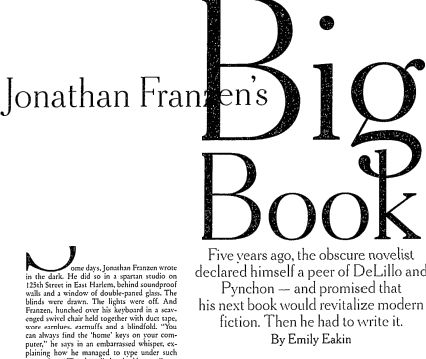
In Sunday’s San Francisco Chronicle, I’ve got a review of Jonathan Franzen’s new collection of essays, Farther Away. While I liked it less than most — I call it “the book of a writer who’s calming down” — that’s only because I liked Franzen’s earlier nonfiction so much. I especially admire “Why Bother?,” which revises and improves on Franzen’s “Perchance to Dream” (better known as “the Harper’s essay”). While researching the review, I found an interesting parallel between “Why Bother?” and “Pain Won’t Kill You,” the first essay in Farther Away, and I’d like to flesh it out here.

But first, it’s worth noting how “Perchance to Dream” became “the Harper’s essay.” As I explain in my review, this happened largely during the publication of The Corrections. Inteviewers kept asking Franzen whether the new novel made good on his promise to “revitalize modern fiction,” as the New York Times Magazine put it in a big profile. The Times traced this back to “Perchance to Dream,” but the essay never made such a promise. Indeed, Franzen has blamed this line of questioning on the Times — and on the interviewers who hadn’t read his essay or his novel. I suspect there’s some truth to this, though I’d also note that the essay’s list of things to stop fretting about (TV, politics, whatever) is presented with such persuasive grumpiness that it’s easy to focus simply on that.

Anyway, when it came time to publish How to Be Alone, Franzen’s first collection of nonfiction, he decided to revise “Perchance” — reordering some paragraphs, removing sour tangents on lit theory and Hollywood screenwriting, cutting a long quotation from a letter by David Foster Wallace. This last edit is pretty interesting, given the competitive relationship between the two authors. One way to understand Farther Away is as a reflection of that relationship — not only in the title essay, on Wallace’s suicide, but in subtler echoes like the fact that Franzen gave “Pain Won’t Kill You” as the commencement address at Kenyon, where Wallace also gave a widely-admired address.

But the larger point is that Franzen’s revisions (and his renaming, from “Perchance” to “Why Bother?”) clarified his essay’s argument. In the introduction to How to Be Alone, Franzen positions the book as “a record of a movement away from an angry and frightened isolation toward an acceptance — even a celebration — of being a reader and a writer.” The Harper’s essay records that same movement. It’s the story of how a person went from caring so much he began to despair to caring just enough that he wanted to do better.

What caused Franzen to change? In his essay, it’s a conversation with a linguistic anthropologist who helped him understand the history and reality of literary reading. In his life, it seems to have been the end of his marriage. Franzen told the Times that he and his wife had lived in “shared monastic seclusion” — sharing a tiny apartment where they both wrote eight hours a day, then read another five. After his divorce, he began making more of an effort to get out into the world. “It would be easy to cast him as the ink-stained wretch who lives in an oubliette and come out blinking into the sunshine every once in a while,” Wallace told the Times. “But Jon finds contact with humans nourishing.” I’d also bet that Wallace’s friendship and letters had more to do with Franzen’s growth than we currently realize (and vice versa).

Whatever the causes, Franzen did change. He describes this in the Harper’s essay as “the shift from depressive realism to tragic realism — from being immobilized by darkness to being sustained by it.” It was this sustainable worldview that allowed him to finish The Corrections.

And that brings us back to “Pain Won’t Kill You” and Farther Away. Late in that address-slash-essay, Franzen talks about how he became an enviornmentalist in college. “The more I looked at what was wrong,” he writes, singling out overpopulation and SUV-style consumption, “the angrier and more people-hating I became.” As his marriage began to dissolve, Franzen decided it best to ignore the environment since there was nothing he could do. “I still tried to keep my carbon footprint small,” he recalls, “but that was as far as I could go without falling back into rage and despair.”

“But then,” he continues, “a funny thing happened” — and that thing is worth quoting at length:

It’s a long story, but basically I fell in love with birds. I did this not without significant resistance, because it’s very uncool to be a birdwatcher, because anything that betrays real passion is by definition uncool. But little by little, in spite of myself, I developed this passion, and although one half of a passion is obsession, the other half is love. And so, yes, I kept a meticulous list of the birds I’d seen, and, yes, I went to inordinate lengths to see new species. But no less important, whenever I looked at a bird, any bird, even a pigeon or a sparrow, I could feel my heart overflow with love. . . .

[By] not merely liking nature but loving a specific and vital part of it, I had no choice but to start worrying about the environment again. The news on that front was no better than when I’d decided to quit worrying about it — was considerably worse, in fact — but now those threatened forests and wetlands and oceans weren’t just pretty scenes for me to enjoy. They were the home of animals I loved. And here’s where a curious paradox emerged. My anger and pain and despair about the planet were only increased by my concern for wild birds, and yet, as I began to get involved in bird conservation and learned more about the many threats that birds face, it became, strangely, easier, not harder, to live with my anger and despair and pain.

Franzen’s point in this essay is that love — ugly, messy love — improved his relationship with the world. But it makes me think of his earlier essay, too. It’s not for nothing that Franzen’s description of love (“a bottomless empathy, born out of the heart’s revelation that another person is every bit as real as you”) sounds a lot like his description of fiction. And I think this shift — from anger-driven environmentalism to love-driven environmentalism, or from depressive realism to tragic realism — explains much of what makes Franzen such a powerful and exasperating writer. It’s why he can seem so cranky and ambivalent. (With categories like these, you’re never entirely one or the other.) But it’s also why he can be so moving and provocative.