Sex, Lies, and Athletic Tape

[Deadspin]

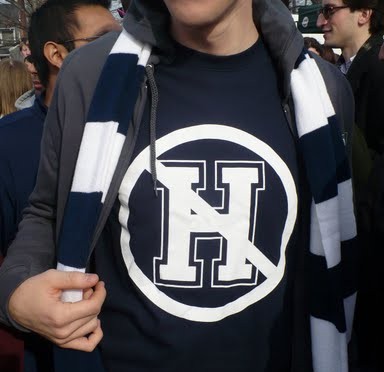
Over at Deadspin, I’ve got a dispatch from this year’s Harvard-Yale game. It’s the 126th time the two have met, and, in both pretension and pageantry, it lives up to your expectations. One of my favorite details from this story was the dust-up over an (allegedly) politically incorrect T-shirt created by Yale students. The administration ended up pushing this anodyne design on the students—but not on too many, judging from the small number I saw at the tailgate.

I’ll include some more photos at the end of this post, but, first, here are a few things I couldn’t fit in. (I should also mention the many helpful books on Ivy League sports—and the fact that, with only two days to turn this story around, I had to skim most of them for the football sections. If the Matt Maloney era at Penn taught us anything, though, it’s that Ivy football is not alone.)

  • Speaking of books: near the end of my story, I mention The Only Game That Matters, a humbly titled history of Harvard-Yale football. Even with its hyper-literate potential audience, this book sold only 3,200 copies (Nielsen Book Scan) and is now out of print—another example of the Harvard-Yale rivalry producing more hype than results. I will point out that, in my copy, checked out from Yale’s Sterling Memorial Library, someone had enthusiastically underlined and starred a passage about how Harvard and Yale’s history predates the United States’. Another passage getting the underline-star treatment? “Beating Harvard was, is, and always will be the yardstick by which joy is measured in New Haven.” This, of course, is complete baloney.
  • One person I talked to while working on the story was Jim Fuller, who covers the Yale football beat for the New Haven Register (and runs a nice blog on the same subject). In 2009, the Ivy League replaced its annual media day with a conference call, and JimĀ argued that this decision will further diminish the League’s relevance. Last year, when a victory over Yale would have given Brown a share of the Ivy title, the Bears’ coach didn’t even come out for interviews because no local media showed up. One other metamedia note: I found it fascinating how many of these odes to the Ivy League mentioned the success former players were having on Wall Street. We’ll have to see how the post-populist coverage of The Game evolves.
  • Let me also draw your attention to “Yale and Athletics” [.pdf], a 1980 address delivered by Yale president A. Bartlett Giamatti. Giamatti—professor of English, commissioner of baseball, and father of Paul—offers a knee-buckling display of erudition. Citing everything from a decade-by-decade comparison of Yale varsity sports’ winning percentage to a long passage from John Henry Newman, Giamatti lays out college athletics’ twinned heritage from the Greeks and nineteenth-century English educators. He also offers some refreshing transparency: “We need always to recall that the production of revenue is as much a part of the picture of Yale athletics as the provision of services and opportunities.”
  • From Bartlett to some quotations overheard at this year’s tailgate: “I was just last weekend at the Stanford-USC game. It’s been a big eight days for me!”; “Man up! It’s Harvard-Yale. Man up!”; “Look, it’s Jeremy Shockey” [This was a Harvard frat guy calling out a Yale frat guy, and I have to say: Yale students struck me as about 30 percent more grating, though this might have been some kind of home-field advantage].

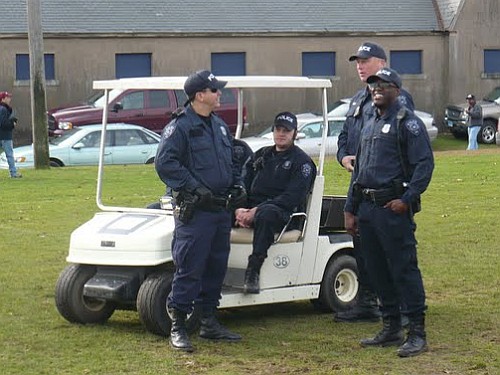
Deadspin ran its own Harvard-Yale gallery, but here are a few I snapped myself. If nothing else, they’ll serve as a reminder that The Game attracts more than just doltish undergrads.

[But doltish undergrads are the most fun, aren’t they?]


Gladwell Agonistes

[x-posted at The Rumpus]

I’m not sure why Malcolm Gladwell’s fourth book, What the Dog Saw, which collects 19 of his New Yorker essays, has been the one to incite a riot of review-essays. Were the first three books not successful enough? Was something in Gladwell’s methodology not previously clear? Were his best and worst traits not yet delineated?

Whatever the reason, the last few weeks have seen a lot of meditations on Gladwell. I’d like to draw your attention to two, one admirable (Steven Pinker’s “Malcolm Gladwell, Eclectic Detective,” the cover review in this week’s New York Times Book Review), one not (Maureen Tkacik’s “Gladwell for Dummies,” in The Nation).

Tkacik begins with a smart point: “That success is in the eye of the unsuccessful would seem to be the great unspoken dilemma dogging critics asked to consider the work of the rich and famous author and inspirational speaker Malcolm Gladwell.” It all goes downhill from there, as she unloads almost 8,000 words of nastiness—a number generously padded by phrases like “Gladwell began studiously scrubbing his sentences of the mildew of the old, liberating his readers from references to anything that might dirty undiluted all-newness with the dourness of precedent.” Tkacik does a fine job summarizing Gladwell’s critical reception (though I’m not sure we really needed that), but, by the end, she seems to be writing a screed against the people who like Gladwell as much as against Gladwell himself.

Then, 180 degrees away, we have Pinker’s essay. It offers all the payoffs of a good review: engaging summaries, sharp observations (e.g., that Gladwell-the-essayist is much better than Gladwell-the-author), and a great sound bite (“The themes of the collection are a good way to characterize Gladwell himself: a minor genius who unwittingly demonstrates the hazards of statistical reasoning and who occasionally blunders into spectacular failures”). When it does come time for a reckoning, Pinker damns Malcolm with his own muffed details; his catch of Gladwell’s “igon valuesā€ is enough to make any writer cringe at the thought of reaching for a fact ever again.

Best of all, Pinker does this in only 1,400 words. Together, his and Tkacik’s reviews serve as a nice reminder that two takes on the same thing can reveal not only different conclusions—Tkacik describes Gladwell’s “recurring straw man” as “misguided evangelism . . . [for] fringe causes,” whereas Pinker finds “the Straw We . . . a kind of populism” that unites Gladwell’s work—but also different impetuses.

“The Grateful Dead Approach to Intellectual Property”

[NUVO]

That quote came from Moira Smith, the librarian for folklore and ethnomusicology at Indiana University. I interviewed Moira for my NUVO cover story on Google Books’ basically unnoticed foray into Indiana, and one question I asked was whether she worried that, by digitizing her books, she would undercut one of her university’s great strengths. IU’s Folklore Collection, you see, has historically attracted NEH grants, prestigious visiting scholars, and all kinds of summer programs.Ā “We think it’s going to have the reverse effect,” Moira continued. “It’s going to be fully searchable, and, from a librarian’s point of view, that’s the best research tool you can have.”

That’s the kind of selfless, access-driven talk the Google Books debate could use more of. As I write at the end of the story:

By digitizing information, Google hopes to democratize it. In this future, it wouldn’t matter if you live in New York or Bloomington, Indianapolis or Elkhart. You could access any book—even, or especially, the one you didn’t know existed.

Anyway, if you’re interested in Google Books or the Indiana arts scene, read the whole thing. Here are a few things that didn’t make the cut:

  • First, three tech tangents I couldn’t fit in: Google Books doesn’t necessarily mean the death of print. The Espresso Book Machine, which is showing up at more and more bookstores, lets you you order any public domain title from Google Books; four minutes and eight bucks later, you’re holding a 300-page book. Another interesting aspect is “character recognition.” Even the best computer programs can’t translate images of text into text as accurately as humans, so Google and its competitors farm this out—each time you complete one of those annoying antispam tests (say typing out the distorted letters at Ticketmaster), you’re actually helping scan books. Finally, just a fact I liked: when Stanford University, in the late 1990s, digitized its card catalog, the number of books checked out increased by fifty percent.
  • If you want more intellectual background on the Google Books settlement, start with Robert Darnton’s great essay in the New York Review of Books. Darnton’s actually pretty anti-Google—under his aegis, Harvard pulled out of the scanning program—so you’ll want to balance him with some Google apologists. I reccomend these essays from The Big Money’s Mark Gimein.
  • “That some kind of systematic indexing of this vast accumulation should be undertaken has been long realized. Though several beginnings of such a work have been made during the past century, no plan has been completed with sufficient thoroughness to warrant general acceptance.” That’s Stith Thompson in the preface to his 1957 revision of his Motif-Index, but the same thing could be said today, of Google’s mission. Many of the academics who criticize Google Books seem to push past this big picture in order to wallow in smaller issues—Geoffrey Nunberg’s essay is a good example of this. In that NYRB essay, Darnton worries about Google Books price-gouging university libraries in the same way that scientific journals have inflated their subscription fees. This makes more sense than most Google Books criticisms, but, as IU’s librarians like to point out, Darnton omits the fact that many of these journals are now struggling with a nasty backlash.
  • Finally, there’s this incredible interview with Michael Hart, the affable, offbeat guy who founded Project Gutenberg in 1971, when they had to type books by hand. (Scanning didn’t start until the late 1980s.)

Review of Memoir: A History

[Christian Science Monitor]

This week, Ben Yagoda’s new book, Memoir: A History, comes out, and I got to review it for the Christian Science Monitor.Ā One interesting thing I couldn’t fit into the review: Yagoda decides to use “autobiography” and “memoir” interchangeably, even though, as he explains, they’ve connoted different things for a while now. In the early twentieth century, “memoir” meant a book that looked outward, not inward, and was held to a higher degree of facticity. Basically, it meant what “autobiography” means today, and “autobiography” similarly defined more “memoir”-ish books.

One thing I do fit into the review is a plug for Yagoda’s book on the New Yorker, About Town, but I’ll do it again—it’s an incredible read, almost 500 exhaustively-researched pages (whereas Memoir is a breezy [and borderline double-spaced] 271 pages).

Do Journalists Conference Too Much about Journalism?

[New Haven Advocate]

It’s shaping up to be a busy (and alt-weekly-ish) day around here. In this week’s New Haven Advocate, I’ve got a short piece that previews this weekend’s big journalism conference at Yale. (Full program here [.pdf].) The conference lineup looks great, but it also looks a lot like the one that presided at Harvard just two weeks ago, and in my preview I speculate on whether we’ve reached some kind of metamedia tipping point.

I realize there’s an easy irony here, what with me only adding to the oversaturation, but there’s also a larger context I couldn’t really get to in the paper. Yale’s conference is being funded by the school’s Knight Law and Media program, which is itself funded by the John S. and James L. Knight Foundation. One of the conference’s speakers is Paul Bass, who edits the hyperlocalĀ New Haven Independent. Bass’sĀ site now has six full-time and six part-time reporters, and together they break more stories than the New Haven Register. Bass keeps innovating, too: in June he launched a second spinoff, the Valley-Independent Sentinel, with a $500,000 grant from none other than theĀ Knight Foundation.

Here are two more numbers to consider: $570,000 and $315,000. Those are the salaries, respectively, for Pro Publica editor Paul Steiger and Texas Tribune editor Evan Smith, and both organizations have received large grants from the Knight Foundation.Ā Now, one more number: $60,000. That’s what theĀ Chi-Town Daily News, a hyperlocal site similar to Bass’s, needed to raise in order to make it to the end of 2009, when several of its grants would have renewed. The Daily News didn’t make it, even though its previous funding sources included . . . the Knight Foundation.

My point here isn’t to highlight the pervasive generosity of the Knight Foundation (though that’s certainly a worthwhile point). Instead, it’s simply that, right now, at least, the pool of nonprofit news money remains a small one, and paying for one good thing means not paying for another.