Great Moments in Advertorial History

I’m wrapping up an essay on the history of the first lady memoir (and wishing I had about a million more words for this topic), but I had to stop and share this ad. It ran in the November 15, 1949 edition of the New York Times (along with a bunch of other newspapers), and it champions a forthcoming issue of McCall’s.

The ad is visually arresting—not only in its own terms, but also in its similarity to the slippery Gawker-like campaigns you see all over the web today.
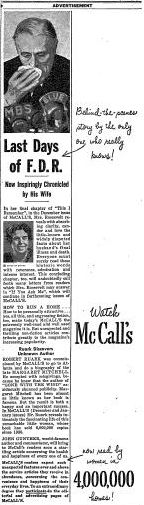
Here’s a detail of the top:
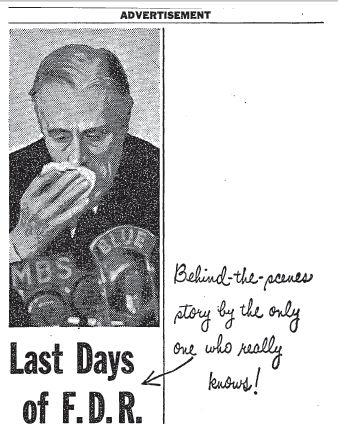
Here’s the first paragraph of the ad:

In her final chapter of “This I Remember,” in the December issue of McCALL’S, Mrs. Roosevelt reveals with absorbing clarity, candor and love the little-known and widely disputed facts about her husband’s final illness and death. Everyone must surely read these historic words with reverence, admiration and intense interest.

Here’s a description of the magazine more generally (ellipses in the original):

HOW TO RUN A HOME . . . How to be personally attractive . . . yes, all this, and engrossing fiction, too, make today’s McCALL’S the extremely well-read and well used magazine it is.

The last bit of faux-handwritten marginalia is McCall’s slogan from this period: “Now read by women in 4,000,000 homes!”
Mark Twain’s Many Mansions

[New York Press]

In this week’s New York Press, I’ve got a story about Mark Twain’s long-forgotten residence in Greenwich Village—and the 1954 crusade to save it. I first discovered this while doing some research (on one of these) for grad school stuff, and I quickly became obsessed with it. As you’ll see in my Press story, though, things got really interesting when I tracked down one of the story’s main players—a British film director who happens to be celebrating his 99th birthday this week. (This week also happens to be the centenary of Twain’s death; they just missed each other.)

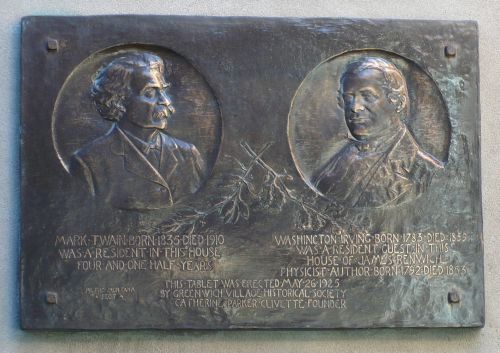
Anyway, the story’s obviously a New York-centric one, so, in deference to all the non-New Yorkers out there, I thought I’d share some photos I took while reporting this. Up top is the plaque—still there at the corner of Fifth and Ninth in Manhattan—that the Greenwich Village Historical Society set up in 1925. (Clara, Twain’s daughter who put up the “NO BILLIARDS AFTER 10 P.M.” sign, was at the ceremony.)

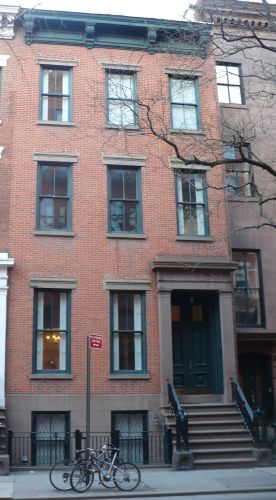
Here’s another 1840s townhouse a few blocks over from the site of the Twain House. (The Twain House, thanks to its architect, included more flourishes than this house: stained glass windows, Romanized details, and a whole lot of wrought iron.)

Here’s the faux-historical sign the developers slapped on the “tall ultramodern apartment building.”

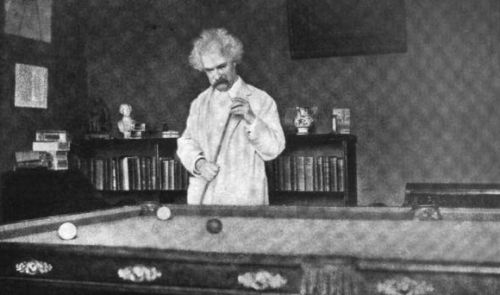
And here’s Twain at 21 Fifth Avenue, chalking his cue. There are a ton of great photos like this in Paine’s three-volume biography, which is available on Google Books. Here’s the third volume, in which, at several points, Paine signals that Twain was a bit of a cheater.

A Brief History of Ghostwriting

[The American Prospect]

In the May issue of The American Prospect, I’ve got an essay on the long, distinguished history of political ghostwriting. A few recent books have touched on this subject, including Robert Schlesinger’s White House Ghosts and Ben Yagoda’s Memoir: A History, but it’s a rich one. My essay, for example, mentions Doris Kearns Goodwin only in passing, but there’s a lot more story to tell.

In fact, Rick Perlstein told it wonderfully in a 2002 essay for the Village Voice. That publication’s notorious website swallowed the essay long ago, but you can still find it via the Wayback Machine. It’s worth reading in full—not only as the best thing written about Goodwin’s plagiarism fiasco, but also as a great meditation on the act of writing history. Here’s a sample:

Historians must write in the grip of an abiding fear. Composing a paragraph one imagines two audiences: the everyreaders, and the three or four people who know more about what you are writing in a particular paragraph than you do, who have read any book you’re inclined to plagiarize, who, for God’s sake, may have written the book you’re inclined to plagiarize. . . . My book is about the 1964 Barry Goldwater election. And the thought of a midnight knock on my door from this guy named John Kessel (who may or may not still be alive), who published a fine academic study in 1968 called The Goldwater Coalition: Republican Strategies in 1964, accusing me of doing him any dishonor, sends chills down my spine.

I’ll add here that, in an age when plagiarists blame their sins on computers and mixed up research files, it’s fun to read Goodwin preaching about reform through “modern technology.” “I now rely on a scanner, which reproduces the passages I want to cite,” Goodwin promises. “I keep my own comments on those books in a separate file so that I will never confuse the two again.” Maybe more relevant to my Prospect essay is the reliance of Goodwin (and plenty of other pop historians) on research assistants. As of 2002, Goodwin employed four—what’s the best term here? Ghostreaders?

Accountability in Publishing

[x-posted at The Rumpus]

Anyone following the fall-out over Charles Pellegrino’s Last Train From Hiroshimahere’s the definitive New York Times story—would do well to read Philip Meyer’s “Accountability When Books Make News,” first published in 1997 in the Media Studies Journal. (You can read it, through the largess of Google Books, right here.)

A terse tour de force, Meyer’s essay starts by outlining what keeps the mainstream media in line: its responsibility to advertisers and to the legal system. “Nothing works as inexorably as the twin forces of the desire to make money and the fear of litigation—the carrot and the stick,” Meyer observes in a nice phrase (and, it must be said, a better potential title for his essay). These factors don’t apply to books, of course—or, Meyer asks, do they? He goes on to discuss, carefully and thoughtfully, the audience, marketplace, and medium of books. He also shows how and where the media piggyback on questionable books—sometimes for the common good (demythologizing J. Edgar Hoover), sometimes not (the craven rumors about George H. W. Bush and a female aide).

None of this correlates to the Pellegrino situation in an A-to-A, B-to-B fashion. At the very least, though, it’s a useful antidote to the Kurt Anderson quote zinging around the blogosphere: “If book publishers are supposed to be the gatekeepers, tell me exactly what they’re closing the gate to.” Anderson makes you nod; Meyer makes you think.

One of History’s Finest Class Projects

[x-posted at The Millions]

In the spring of 2006, John Unsworth taught a graduate seminar on “Twentieth-Century American Bestsellers.” It led to one of history’s finest class projects—a browsable database of bestsellers, 337 in all. As with any bestseller lists, you’ll find a range of titles, everything from Thomas Wolfe to Tom Clancy, but each entry includes an extremely detailed description of the book’s history (these were compiled by grad students, after all); a mini-essay on its reception; images of covers, page layouts, even some ads; and much more. It is, in short, bibliophilic crack.