The Drudge Report and Bush’s Decision Points

[New York]

In this week’s New York magazine, I’ve got a short little essay arguing that presidential memoirs exist not to be read so much as to be discussed. That’s clearly the case with Bush’s new Decision Points, though the full details of his TV tour didn’t surface until after my story had gone to press. Still, the history of this genre — or, more accurately, the history of the promotion of this genre — gave me more than enough to go on. Bush’s book, like all presidential memoirs, will matter less as a weighty tome than as a multimedia launching platform. While all of the media depend heavily on books — think of the forthcoming reviews, Op Eds, and blog posts digesting Decision Points’ greatest hits — the most important format will be the least bookish: television. At one point in my essay, I mention the now-forgotten TV genre of the “electronic memoir.” Well, there’s no need to sell an electronic memoir when a book will accomplish the same thing: getting you and your message on TV.

That’s what’s happening with Bush’s presidential memoir, and that’s what’s been happening since Truman’s. Still, there are a few new things about the promotion of Decision Points: a book trailer; an elaborate and viral-friendly Facebook contest; and what sounds like an amazing ebook, which will include the text of Bush’s speeches, some of his home movies, even handwritten letters and extra photos. (Decision Points won’t be the first presidential memoir ebook, surprisingly enough — there was a palmOne edition of Clinton’s My Life.) But the weirdest digital aspect of this is that the first real details from Bush’s book appeared on The Drudge Report. Media reporters got pretty sloppy here: most of them described this as a “leak,” and some even assumed Drudge had the entire book. But there’s no reason to believe any of that. After his “**Exclusive** **Must Credit**” throat clearing, Drudge wrote:

“It was a simple question, ‘Can you remember the last day you didn’t have a drink?'”

So begins President George W. Bush in the opening chapter [“Quitting”] from the most anticipated book of the season, the DRUDGE REPORT can reveal.

Drudge wouldn’t respond to my requests for comment. But that “can reveal” seems pretty telling. In fact, if I had to bet, I’d say Crown leaked him this information directly. The publisher’s employees haven’t kept especially quiet about Bush’s book (for example). And they can’t be unhappy with what Drudge wrote. Indeed, when it comes to leaks, Crown couldn’t have — I don’t even know what the right metaphor is anymore: scripted? written? — a better result.
By Committee

[New York Times]

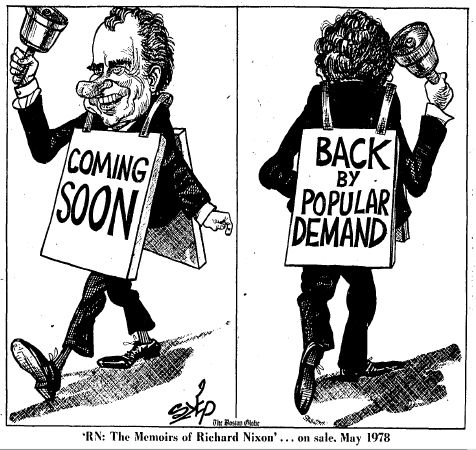
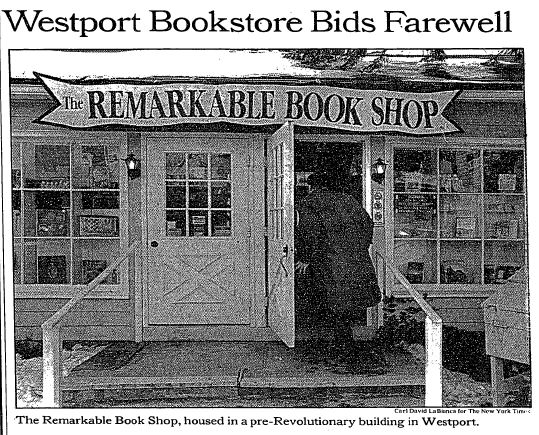
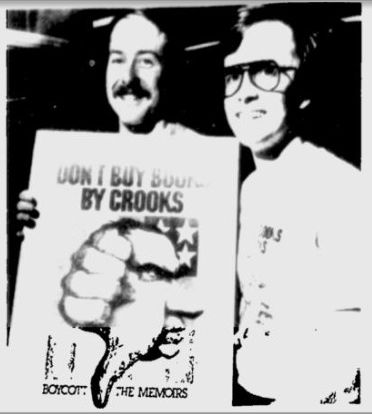
In this Sunday’s New York Times Book Review — and just in time for the release of George W. Bush’s memoirs — I’ve got an essay on the crazy (but long forgotten) protests surrounding the release of Richard Nixon’s memoirs. My cast of characters includes Tom Flanigan and Bill Boleyn (pictured above), the co-founders of the Committee to Boycott Nixon’s Memoirs, and Sid and Esther Kramer, the co-owners of Westport, CT”s Remarkable Book Shop (pictured below). Really, though, it includes just about everyone living in 1978 — because RN: The Memoirs of Richard Nixon came with a degree of media hype achieved by no presidential memoir before or (so far) since.

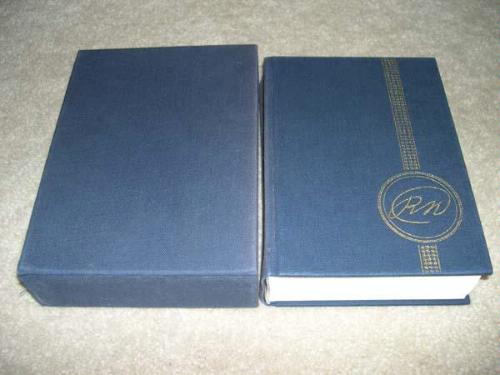
For further proof of this, check out this contemporary news broadcast (YouTube) and, below, some great caricatures of Nixon as author. I also wrote a blog post for the Times about the two “deluxe” editions of Nixon’s memoirs — this phenomenon of presidential publishing also occurred with Carter’s, Reagan’s, Clinton’s, and, now, Bush’s books — and there are some images of those editions. After that, as promised, a few old newspaper photos of the Remarkable Book Shop. Sid told me that, when the RBS closed in 1993, Paul Newman called him and said, “Don’t close — you can’t close.”

The New Republic (1974)

The New Republic (1978)

Boston Globe (1978)

*  *  *

RN‘s $50 “deluxe” edition, with slip case

RN‘s $250 “numbered presentation” (and
leather-bound and gold-detailed) edition

The “numbered presentation”
edition’s certificate of authenticity

The first volume of Warner’s paperback edition ($2.95)

*  *  *

The RBS in the 1960s (Dan Woog)

New York Times (1994)

New York Times (1987)

New York Times (1994)

A Profile of Jill Lepore

[Boston Globe]

In this week’s “Ideas” section of the Boston Globe, I’ve a profile of Jill Lepore and her new book The Whites of Their Eyes: The Tea Party’s Revolution and the Battle over American History. Lepore was a great interview. (A couple of favorite [and context-free] lines: “I drink my cup of coffee and I think about the history of coffee. In my brain, everything unfolds on a time line”; “Arthur Schlesinger didn’t have to deal with email.”)

Lepore’s also written an interesting, if uneven, book. One thing I couldn’t get to in my profile was her critics within the academy. Lepore’s smartest move in The Whites of Their Eyes may be accusing the Tea Party of presentism — the Bicentennial was also, in Lepore’s phrase, “a carnival of presentism” — because this makes it harder to level one of history’s dirtier words at her. (The president of the American Historical Association defines presentism as “the tendency to interpret the past in presentist terms.”) Still, that’s exactly what people have done to her previous work. Consider the end of Brendan McConville’s blistering review-essay of Lepore’s New York Burning:

The unintended lesson within New York Burning is for those of us who study early America, and it goes something like this: colonial Americans aren’t like us, and that is what is truly disturbing and fascinating about them. Efforts to make their lives a long prologue to the emergence of our own world don’t work, even though some things they did clearly affect us.

I will say that, when it comes to writing about complex historical ideas for popular audiences, I’ve developed a lot of sympathy for Lepore. In the profile, for example, I wanted to explain why Sharron Angle was crazy to call Jefferson and Franklin “social conservatives.” Jefferson was easy enough — as was Franklin, if I’d talked about his views on gender inequality. But I figured I had to broach the issue of slavery at some point in a story on colonial America, so I went with Franklin’s abolitionism. Problem is, I’ve read David Waldstreicher’s excellent Runaway America: Benjamin Franklin, Slavery, and the American Revolution, a book that shows this matter is much more complicated than simply referencing Franklin’s run as president of the Pennsylvania Abolition Society. I had to finesse the point, and quickly. I’m embarrassed to say one draft had “Franklin’s semi-abolitionism,” which my editor smartly shot down. “Franklin’s public abolitionism” might not be much better, but I hope it at least registers the skepticism conveyed in Waldstreicher’s book. It’s a small example, but one that nicely illustrates the difficulties in practicing responsible public history.

One more thing: it’s worth rewatching Santelli’s original “rant heard round the world,” if only for the studio’s confused reactions. “It’s like mob rule there” and “he’s a rabble-rouser” —  no surprises there, but how about this line: “Rick, I congratulate you on your new incarnation as a Revolutionary leader.”

Brace yourself: the latest, greatest edition of Mark Twain’s Autobiography is almost here

[Slate]

At Slate, I’ve got an essay on the crazy behind-the-scenes history of Mark Twain’s Autobiography and its various editions. The latest one just arrived, and, over the last six months, it’s been getting some unbelievable hype, thanks in large part to Twain’s instructions that it not be published until 100 years after his death. But I try to show that this story is now repeating itself for the fourth time — and that there’s not that much new in Twain’s new book. Twain clearly overestimated the scandalousness of his autobiography. (Van Wyck Brooks gets the best line on this: “He is going to have a spree, a debauch of absolutely reckless confession. He is going to tell things about himself, he is going to use all the bold, bad words that used to shock his wife.”) But what if he always intended the embargo as more of a marketing stunt than anything else? That’s the question I kept in mind while researching and writing my essay. And if this is what Twain intended, it worked better than even he could have hoped.

One thing I couldn’t get to in the essay was my problems with the new edition of Twain’s autobiography, which is coming out from the Mark Twain Project and the University of California Press. (What follows is of such limited appeal that I’m going to assume you know who Paine, DeVoto, and Neider are.) The new edition promises to be a major scholarly event, but it’s being treated like more of a popular or literary one. And the editors at the Twain Project have gleefully nodded along with the media’s embargo-driven excitement. (Well, they did push back on the vibrator.) In July, the Twain Project supplied the New York Times with “some of Twain’s spicier comments” for the newspaper’s front-page story on the new edition. But those comments were all published back in Paine’s edition! The attack on Theodore Roosevelt appears, in full, in Paine. So does the comment on Thanksgiving Day (though Paine fussily [and typically] swapped Twain’s “consequently” for “hence”). And while Paine did hold back some of the nastier flourishes in the third example, he still included Twain’s riff that Christianity “is now nothing but a shell, a sham, a hypocrisy.”

Here’s what the Times‘ reporter concluded:

In his unexpurgated autobiography, whose first volume is about to be published a century after his death, a very different Twain emerges, more pointedly political and willing to play the role of the angry prophet.

This simply isn’t true. That Twain emerged a long time ago; whether or not we’ve noticed is a different matter. I don’t fault the Times‘ reporter for this, just like I don’t fault Granta for hyping its “exclusive first excerpt” of Twain’s autobiography, an excerpt that appeared in full in both Paine and Neider’s editions. But I do fault the Twain Project. Again, as scholars, the editors at the Twain Project have done incredible work. They’re going to put the full autobiography (and its enormous number of variants) online for free. They’ve devoted 300 of the new volume’s 700 pages to a terrific textual apparatus. But these scholarly bells and whistles just make the Twain Project’s complicity with the hype that much more disappointing.

It also makes their treatment of Neider and DeVoto unconscionable. DeVoto represented an enormous improvement over Paine, opening the Twain Papers up to other scholars for the first time. (I’ve developed a bit of a scholarly crush on DeVoto and will, at some point, try to write another post on him and Twain.) But Neider and DeVoto show up in the new edition of Twain’s autobiography only to get knocked down. In what passes for an insult in scholarly circles, the editors at the Twain Project note that DeVoto modernized Twain’s punctuation “with great satisfaction.” There’s little mention of Clara’s crushing influence — which was, if anything, worse than what comes across in my Slate story. DeVoto and Neider were passionate, hard-working, underpaid scholar-critics who introduced Twain’s autobiography to several generations of readers. It’s a mistake to slight either their efforts or the impossible conditions under which they labored. In fact, even more than aiding and abetting the embargo-driven hype, it is a form of scholarly malpractice.

The Dabbler

[New York Press]

In one of several recent cover stories — this one in The Advocate — James Franco complained about the early reactions to Palo Alto, his new collection of short stories:

If websites like Gawker.com or PerezHilton.com don’t like my writing, I can live with that. There is this crazy phenomenon in the blogosphere that is so hostile to anyone being creative, and if I incur that hostility from people who’ve probably read five short stories in the last 10 years, it doesn’t really bother me.

Fair enough. Gawker commenters dismiss Franco reflexively, while commenters on pure entertainment sites endorse him in the same way (sexy AND smart!). His new book does deserves a serious review, and that’s what I tried to give it in the New York Press.

The result, in short, is not pretty — better than Rivers Cuomo, but not nearly as good as Ethan Hawke. I have yet to run into Franco, here in New Haven, but I’ve got nothing against him personally and enjoy more than a few of his movies. As I mention in the review, I think it’s great that he’s going to grad school. But I also think that publishing a book is different. And that’s the main point I wanted to make: his book has siphoned editorial attention, effusive blurbs, media buzz, and literary shelf space from other, better books.

Let me give a positive example. Sam Munson’s The November Criminals, a debut novel I reviewed for the Wall Street Journal, is a wonderful read with all kinds of interesting and important things to say. Munson sets one great scene in a high school classroom, which happens to be the setting for one of Franco’s better short stories, too. It’s worthwhile to parallel them.

The November Criminals stars Addison Schacht, a nihilistic teenager who would fit right in with Franco’s cast. (Addison actually sells pot, so this would solve one of Palo Alto’s mysteries: where the characters get all their illicit substances.) Anyway, Addison is sitting in his English class, enduring a facile discussion of The Aeneid, his favorite book. When one of his pretty, smarmy classmates starts talking about how Virgil “glorified violence” and “prevented dialogue,” Addison loses it:

I launched into a speech, in a choked voice. ‘No, man, you’re missing the whole point. You can’t apply our virtues here. You can’t! They were operating under a whole different set of ideas. You can’t judge them. . . .

The scene goes on for another page or two (you can read it here), and there’s plenty of funny details and snappy writing. What makes it so good, though, is its relationship to everything that comes before and after. The whole novel is about judging — and about Addison’s attempt to make it through life with both evaluative standards and a measure of empathy. Munson manifests this in some interesting political ways, which I talked about in my Journal review. But it colors every interaction in the novel, including this one. It’s smartly done and terrifically open-ended.

Now, back to Franco. In “American History,” a history teacher has his class “act out a mock debate between the slave states and the free states.” Jeremy, the narrator, takes this assignment a little too seriously, offending several other characters, getting beat up, and creating a couple of genuinely and uncomfortably funny exchanges (“‘Hitler is timeless!’ screeched Stephen”). But this is marred by the writing — the “rocky stream” example I singled out in my review comes from this story — and, even more, by the motivations. Jeremy, it turns out, did it all for a girl. And the girl didn’t even notice.

This doesn’t ruin Franco’s story, by any means. But it does prevent it from achieving the insights and inventive appeal of something like The November Criminals. One of the more interesting things about adolescence is that, as in every stage of human development, each person remains very different. But in adolescence, we all try so hard to fit in. That’s a great dynamic for fiction to explore. Munson’s does. Franco’s, not so much.