Broadcasting live from Great American Ball Park

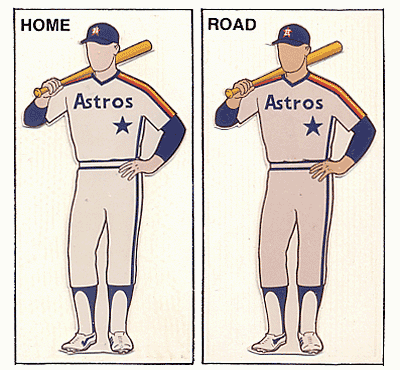
I’ve been a Cincinnati Reds fan for as long as I’ve been a sentient being. I remember getting my adjustable foam hat signed by Marge Schott — or, technically, signed by “Schottzie II.” I remember struggling to understand the Houston Astros’ accent colors, their bright orange stripes set off by the brighter green Astroturf at Riverfront Stadium. I remember watching Barry Larkin hit the home run that gave him a 30-30 season.

What I don’t remember, though, are the good times. That’s because there haven’t been many for Reds fans my age (26). The closest I can come is 1999, when I sat next to my dad in what was now Cinergy Field, in right field, in the red seats, in the stadium’s next to the last row, and watched Al Leiter and the Mets two-hit the home team to win a one-game wild-card playoff.

So, yeah, not a lot of good times from the late 1990s and the 2000s. That’s why I’m so excited for tonight, when the Reds kick off a seven-game home stand against the St. Louis Cardinals — a home stand that actually means something, since the Reds won their division last year and have a chance to do so again, and a home stand I’ll be attending in full while I work on a story on the Reds and their fans. In fact, I’m writing this from the Great American Ball Park press box. On my walk over, I saw Joey Votto pulling into the stadium’s parking garage in his jet black Lamborghini. When I made it to the press box, Hal McCoy introduced himself, then, very graciously, pointed out that I was sitting in the scouts’ section. By the time I got resituated, it had started raining — it hit the river first, roiling the water, then the field (they barely got the tarp on, had to weight it down with golf carts), and now it’s beating against the press box’s glass windows and, from the sound of it, leaking through the ceiling.

*  *  *

Who cares about the weather, though, so long as it lets up by 7:10? On this blog, I plan to post a few random thoughts and extra scenes throughout the week. For now, and for some perspective, I’ll resurrect a particularly painful memory. It comes from a couple months after that one-game playoff, when the Reds, fresh off their 96-win season, traded for Ken Griffey, Jr. The team gave Griffey a $112.5 million contract — almost twice what Carl Lindner had paid for his controlling share of the team the year before — and prepared for a dynasty. You think I’m exaggerating? Check out the first few paragraphs from Tim Sullivan’s Cincinnati Enquirer column, something he wrote right at the honeymoon’s start.

Ken Griffey Jr. changes everything. He makes the beer colder. He makes the girls prettier. He makes the Cincinnati Reds synonymous with style and grace.

He makes baseball bigger. He makes Cincinnati matter. Eighteen years to the day after Dick Wagner finished dismantling the Big Red Machine — trading George Foster to the New York Mets because no ballplayer was worth $2 million a year — Junior Griffey came home Thursday night and ended Cincinnati’s small-market era.

From here on out, the home team operates on a higher plane — culturally, financially and orbitally. Griffey’s supersonic swing — the most lethal uppercut since Rock ’em-Sock ’em Robots — gives the Reds their strongest power source since Foster left town in 1982. His command of center field conjures the best days of Eric Davis, without all the injuries.

“You look at Junior,” Reds first baseman Sean Casey said Thursday, “and you’re kind of in awe.”

No player since Willie Mays has blended baseball’s basic skills in a more breathtaking package than Ken Griffey Jr. No player since Pete Rose has tugged so tenaciously at Cincinnati’s heartstrings. Not since Babe Ruth left Boston for New York 80 years ago has a baseball transaction carried such obvious clout.

“Feb. 10, 2000,” Reds General Manager Jim Bowden said. “That date will go down in Reds history.”

For media overkill, shameless grandstanding and claustrophobia, Thursday’s trade announcement may be unsurpassed in the annals of horsehide. Politicians lined up for the photo opportunity as if Carl Lindner were dispensing campaign contributions instead of baseball cards of himself.

Such is the star power of Ken Griffey Jr. At 30 years old, he is at the peak of his form, and on a pace to make mockery of the home run records. And he’s all ours through 2008. Pinch yourself if you please.
The Non-Controversy over Barack Obama’s Of Thee I Sing

Earlier this week, we put to rest one of the right wing’s more durable political myths. To celebrate the occasion — and to remind us that these myths can be big or small and can originate on the right or the left — I’d like to return to a idiotic mini-scandal from last year. Let me say upfront that everyone has moved on and no real harm was done. Still, the procedures and incentives that created this kind of nonsense still hold, and we’ll see many more stories following this template in the next 18 months.

Anyway: in November of 2010, Barack Obama published a children’s book, Of Thee I Sing. It was the latest in a long line of presidential children’s books — see other entries by Theodore Roosevelt, JFK, Jimmy Carter, Hillary Clinton, and Laura and Jenna Bush — and an even longer line of celebrity-written children’s books. (Whether celebrity book vs. presidential book remains a useful distinction is a topic for another post.)

Nevertheless, in the days surrounding its release, Of Thee I Sing set off a series of controversies. The first  — doesn’t Obama have something better to do than write a children’s book? — was quickly defused by his publisher and his agent: he wrote the book after the election but before the inauguration, and the illustrations caused the delay. The second controversy — is Obama cashing in on his presidency? — was never more than notional. Of Thee I Sing sold 50,000 copies in its first week, but, as the AP reported, Obama donated “his proceeds to a scholarship fund for children of disabled and fallen soldiers.”[1]

The book’s third controversy, however, could not be so easily dismissed. When Fox Nation linked to a USA Today story about Of Thee I Sing, it added its own headline: “Obama Praises Indian Chief Who Killed U.S. General.” (Sitting Bull is one of the 13 figures Obama profiles in the book.) Over the next 48 hours, the online world’s usual suspects — media criticsaggregators, pundits, Gawker — came together to criticize Fox News for its hyper-partisan behavior. AOL’s Politics Daily commissioned a 1,000 word feature, complete with expert interviews and a larger import.

But here’s the thing: the only glimmer of conservative outrage came in that first headline, which Fox Nation quickly changed “for historical accuracy.” (The afore-linked stories also included a few online comments, sure, but the journalistic habit of quoting online commenters is its own sick joke.) This story lived and died on the left; the right never even noticed. The whole mess underlines the fact that attacking everything Fox News does is now as ingrained as Fox News attacking everything Obama does. Another way to say this is that Fox News wasn’t the only media outlet willing the Of Thee I Sing controversy into being. I’m not sure who won the day, but we all lost it.

———————

[1] This probably isn’t the full truth. Of Thee I Sing was the last in a three-book, $1.9 million deal Obama signed with Knopf in 2004 — the publisher had originally promised this book would be the childhood autobiography of a “skinny young kid with big ears and the funny name” — but I never saw anyone ask if the “proceeds” include part of his advance.

A Review of David Foster Wallace’s The Pale King

[San Francisco Chronicle]

In Sunday’s San Francisco Chronicle, I’ve got a review of David Foster Wallace’s The Pale King. This novel isn’t exactly hurting for attention, but I do try to make a couple of fresh points: first, that Wallace has always been a novelist of ideas; second, and contrary to what most reviewers have been claiming, The Pale King isn’t really “about boredom,” though the idea of boredom does let Wallace get at a lot of his bigger concerns.

One thing  every reviewer can agree on is that The Pale King reveals a softer, more reader-friendly side of Wallace. But that was to be expected. Back in 1993, Wallace told an interviewer that he wanted to stop writing sentences that were

a real bitch to read. Or bludgeoning the reader with data. Or devoting a lot of energy to creating expectations and then taking pleasure in disappointing them.

I’m not sure Infinite Jest lived up to those goals, despite its many pleasures and successes. In that novel’s aftermath, though, Wallace promised to try harder. “For somebody who comes out of a more theoretical avant-garde tradition,” he told another interviewer, “I think the aging process is a thawing process.” Wallace clearly fits in that tradition; when The Pale King‘s “Author’s Foreword” cheekily started on page 65, I thought of Robert Coover’s Pricksongs and Descants, which starts its dedication to Cervantes on page 76. More to the point, Wallace clearly went through that “thawing process,” which means The Pale King now stands as the best introduction to his work and worldview. Think of it as a novel-in-short stories — one of those books where characters and narratives and ideas interact and intensify without building into a larger whole.

Two points about Wallace’s first novel, The Broom of the System. Several reviewers, along with Michael Pietsch in his “Editor’s Note,” have pointed out that this book ends mid-plot and even mid-sentence — and thus reinforces the idea that The Pale King‘s unfinished state shouldn’t hold anyone back. I agree with the sentiment, but want to note that Wallace later regretted The Broom of the System‘s cutesy non-ending. His agent, Bonnie Nadell, then his editor, Gerald Howard, had begged him to come up with a new ending to satisfy the readers who finished this demanding book. But Wallace refused. “It was written very quickly, rewritten sloppily,” he admitted in a later interview. “Sound editorial suggestions were met with a seventeen-page letter about literary theory that was really a not-very interesting way — really a way for me to avoid doing hard work.”

The other thing to say about The Broom of the System is that, already, Wallace was working on his idea-driven method. In another early interview — one that’s rarely mentioned, but available here as a .pdf — he said that “I didn’t start writing fiction until I was twenty-one, and at the beginning we all have to write our requisite amounts of shit, and my shit was basically disguised essays. They were like really bad Ayn Rand or something.” The transition from these two points to The Pale King — that’s why the Dostoevsky quotation at the end of my review felt so autobiographical.

I’ll end with a Franzen / Wallace comparison, in honor of the former’s New Yorker essay on the latter. (You might say that Franzen did some thawing between The Corrections and Freedom — too much thawing, in fact.) I think it’s well worth rereading Wallace’s Kenyon commencement speech alongside The Pale King in the same way people read Franzen’s famous “Perchance to Dream” essay alongside The Corrections. In both cases, you’ve got a nonfiction manifesto that correlates to the ideas behind the fiction. Wallace’s ideas may seem more social, and Franzen’s more aesthetic, but there’s a ton of both in both. The friendly rivalry between those two fascinates me. I can never decide if Wallace is Hemingway or Fitzgerald.

Writing the Civil War

[Boston Globe]

In this week’s Boston Globe — and exactly 150 years after the start of the Civil War — I’ve got a feature on the war’s impact on American literature. For pretty much all of those 150 years, people have been wondering why the Civil War didn’t produce any great contemporary works of literature. What gets overlooked in this is the number of great authors who did live and write during the 1860s: Whitman, Hawthorne, Melville, Emerson, and more. The history of American war writing stretches back at least to 1638, when Captain John Underhill chronicled the Pequot War in Newes from America. I learned that in Cynthia Wachtell’s excellent War No More: The Antiwar Impulse in American Literature. Still, the focus of my feature is Randall Fuller’s From Battlefields Rising: How the Civil War Transformed American Literature. Taken together, Wachtell and Fuller’s books suggest that, while the Civil War lacked a true literary masterpiece, it did clear the way for the antiwar writing we recognize today.

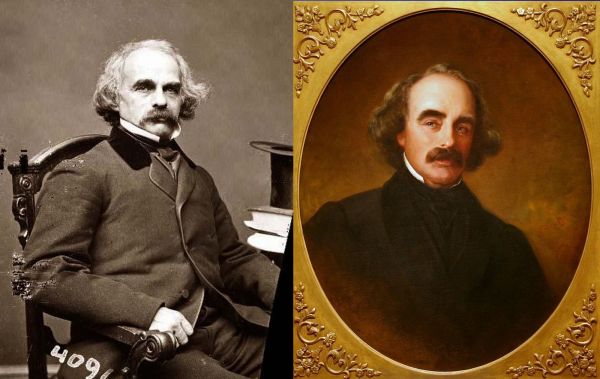
I want to expand on two things I didn’t have space for in my feature. First, the role of photography in the Civil War. Plenty of scholars have argued that this newish medium — notably through Mathew Brady’s 1862 gallery of Antietam — went a long way toward making the Civil War the grisly, realistic, and transformative experience it so surely was. But Fuller connects this idea to literary authors. While in Washington reporting “Chiefly About War-Matters” (the essay remains a great read and can be found here), Hawthorne sat for two visual portraits. The first (pictured above right) was a painting by none other than Emanuel Leutze, who remains best known for his Washington Crossing the Delaware and Westward the Course of Empire Takes Its Way. The second (above left) was a photograph by Alexander Gardner, the Brady photographer who supplied many of the Antietam shots.

The contrast between these two portraits gets at how transitional this moment was for visual culture.  But it also gets at the difference between painting and photography — a difference that played out in the war coverage, where, for the first time, people could choose between the sanitized, sentimental drawings in publications like Frank Leslie’s Illustrated Newspaper and photographs. When the New York Times wrote up Brady’s gallery, it praised its “terrible reality and earnestness.” “If he has not brought bodies and laid them in our dooryards and along the streets,” the Times continued, “he has done something very like it.” Hawthorne looks a lot better with the help of Leutze. The same was true of the Civil War’s violence.

Second topic: Walt Whitman’s taste in opera. At the start of my feature, I tell the story of Whitman walking out of the opera on the night of April 13, only to learn about the attack on Fort Sumter. Scholars love this anecdote for all the obvious reasons, but they disagree on the show Whitman attended. Most say it was Verdi’s Ballo in Maschera. But a few, like Mark Caldwell, in his cultural history New York Night: The Mystique and Its History, say it was Donizetti’s Linda di Chamounix. Curious, and wanting to get this right, I emailed Professor Caldwell to ask him why he went with Donizetti.  In a gracious and detailed reply, he explained that according to the listings Verdi was a matinée on April 13, while Donizetti was an evening performance on both April 12 and April 13.

Now, the news about Fort Sumter arrived in New York via telegraph on the afternoon of the 12th. This means neither show matches up perfectly with Whitman’s own account of hearing the news — an account he wrote more than a decade after the fact. Professor Caldwell told me he placed more weight on Whitman’s description of reading the news at night than on his specific mention of the 13th of April. That makes perfectly good sense. I did some more reading around — I didn’t see anyone air this debate out fully, though someone surely has — and decided to put more weight on the documented lag between telegraphs and newspapers and on Whitman’s ability to kill a few hours in Brooklyn. I hope that makes sense, too. Either way, Whitman had seen more than 20 opera performances before this one. He would have been happy with Verdi or Donizetti or both.

Reprinting Reagan

I’m switching gears to work on some long-term projects, which may mean fewer story links and deleted scenes. That said, I want to keep writing regularly, so the plan is to do more short, standalone posts. They might be a little dated, but I hope they’ll also be interesting. Expect lots of presidents, publishing history, and weird-slash-strangely familiar stuff from old media sources.

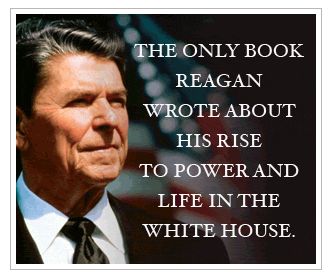
So, in that spirit: while researching Jack Cashill’s crackpot theories about the real author of Barack Obama’s books, I came across the following web ad:

It seems that, in honor of Reagan’s birth centennial, Simon & Schuster has decided to reissue An American Life, his presidential memoir, in hardcover. Immediately after his death, in 2004, the publisher also rushed out a fresh batch of 10,000 copies. But this is something new. First, there’s the targeted online ad campaign. (I saw this one here.) Then there’s the brand new online book trailer. “Thousands of books have been written about Ronald Reagan’s presidency,” the trailer opens. “Only one in his own words.”

Most interesting of all, though, is Simon & Schuster’s release of a new “enhanced ebook” that combines Reagan’s text with contemporary videos. It’s a smart and relatively easy move since Simon & Schuster is now owned by the CBS Corporation, which of course owns all the news footage one would ever need. But political books often end up in these sorts of multimedia experiments. Rick Perlstein’s Nixonland was Simon & Schuster’s first “enhanced ebook,” with 27 videos interpolated into the almost 900 pages of text. Sarah Palin and Ted Kennedy’s plain old ebooks became important data points in the publishing industry’s attempts to delay ebooks in order to goose hardcover sales. And way back in 1990, for its original release, Reagan’s An American Life became the first presidential memoir audio book.

In a forthcoming academic article, I’ve got a lot more to say about Reagan’s career as an author, which is much more interesting — and much more rewarding — than you might initially think. I’ll post a .pdf of it when the journal issue comes out. Let’s hope that happens in 2011, so we can keep riding the birth centennial wave.