Cincinnati TV, circa 1972

I’m way behind on posting extra Reds material, mostly because I’m struggling with a revision to the Reds story itself.  But I wanted to throw up a link [warning: huge .pdf] to this wonderfully weird essay from 1972. It’s by Robert L. Steiner, then a professor at UC, and is titled “Visions of Cablevision: The Prospects for Cable Television in the Greater Cincinnati Area.”

This is a fun read (or at least a fun skim) for several reasons. First, it reminds you of the time when cable TV was still new and, for network TV, still scary. (In fact, a lot of the essay’s rhetoric can map on to current debates about cable TV vs. the Internet. ) Second, it reminds you of how much Cincinnati’s entertainment options have changed. At this point, the very first Mayor Luken was assembling a “Task Force on Urban Cable Communications” — and only a handful of Reds games were cropping up on TV, and then only on WLWT (still the local NBC affiliate). Third, it’s just an bizarrely written document that moves from technical diagrams of coaxial cable to discussions of old FCC rulings to TV viewing habits in Akron, Ohio.

Steiner does all this in a folksy style, as well. I’ll include a bit from one section on the rights to sports and movies — what Steiner calls “the steak and fried chicken of the television menu. Remove them from the menu, and you may as well close up the restaurant.” Again, it’s weird, but for the right reader in the right mood, it’s a lot of fun.

I survived sports talk radio

Yesterday, after the Pirates finished off the Reds, I left Great American Ball Park for the last time and headed to the Clear Channel radio studios. Despite I-71’s best efforts to stop me, I made it in time to talk to Mo Egger of ESPN 1530 AM from 5 to 6. Thanks to him and his callers for giving me some more perspectives for my story on the Reds and their fans. I thought it turned out pretty well, other than some microphone hijinks at the beginning. You can listen to it here.

The more things change . . .

Everything people worry about in baseball today is right here in this short, unbylined item from December of 1951. You’ve got your revenue sharing (i.e., road attendance); your anxieties about new media and new distractions (television); your sales and marketing (the studying of television); your highly selective self-presentation (in reality, the biggest problem was the Reds’ home attendance, which, at 588,688, ranked next to last in the league); your whining about short-term losses while staying quiet about capitalization (within ten years, Bill DeWitt, Sr., would pay $4.6 million for the Reds); and your fetishizing of player development. In fact, the only surprise is that teams actually used to disclose such things.

Cincinnati Reds Lost $42,355 Last Season

Cincinnati, Dec. 18 (AP) — The Cincinnati Reds lost $42,355.62 last season, stockholders were told last night at their annual meeting.

Failure to draw on the road was the big factor, since the club increased its home attendance 49,474 over the 1950 season. It played to only 655,588 fans on the road — 146,585 less than the year before.

In making his report, Powel Crosley, Jr., president, said it was difficult to determine the effect televising of games has on attendance.

Cincinnati televised only weekday afternoon games last season, and it indicated the club would continue the policy in 1952.

Crosley, who was re-elected president at today’s meeting, said he was hopeful of more fruitful returns from the club’s farm system and working agreements with minor league teams.

“The standings of the clubs on our farm organization last year was pretty low and I think they can be improved,” he told the meeting. “It is also quite possible that more promising young ball players will be brought into the organization. This is a very important matter.”

Gabe Paul was re-elected vice president and general manager; Lewis Crosely, vice president; and T. M. Conroy, secretary and treasurer.

bin Laden and the Millennials

[Los Angeles Times]

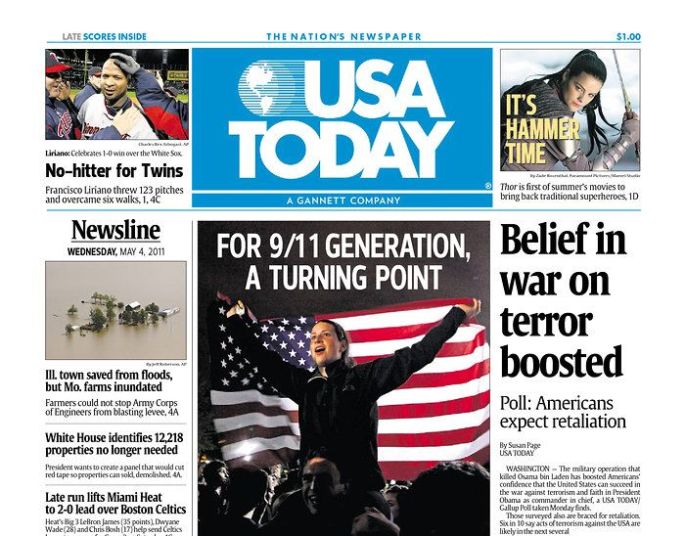
In Sunday’s Los Angeles Times, I’ve got an op ed on Osama bin Laden’s influence on the Millennial generation — and on the media’s lazy obsession with this angle. Neither poll data nor anecdotes support the idea that bin Laden haunted Millennials in any unique or lasting way, and their attention-mongering reactions — a favorite example: the Ohio State students who jumped into Mirror Lake, an act they normally save for the off chance that they beat Michigan — reveals more about their narcissism than their historical consciousness. In fact, in my op ed I end up arguing that the best way to understand Millennials is not in their relationship to bin Laden, but in their reaction to his death.

I want to include some links to the media coverage and to highlight a couple more Yale-bin Laden connections. (Since I’m a graduate student there, I pegged the piece to Yale’s student reaction.) But first, I’ve got to say more about the whole idea of a Millennial generation (i.e., people born between 1980 and 2000).

“Millennial generation,” which seems to be outlasting “Generation Y,” “the Facebook Generation,” and its other competitors, first appeared in Neil Howe and William Strauss’s 2000 book Millennials Rising. That date is important, because many of the generational traits Howe and Strauss would later attribute to 9/11 — Millennials are more public-minded, more self-aware, etc. — were first articulated in a book that came out more than a year before September 11. But that’s the value of generational thinking. It not only simplifies the gradual and messy progress of history (see this very good Chronicle of Higher Education piece for more on that), it can also be adapted on the fly. In fact, by September 12, 2001, Howe and Strauss were going on cable TV and explaining how 9/11 would shape Millennials.

So it’s no surprise that Howe’s been busy playing up the Millennial-bin Laden connection. (Strauss passed away in 2007.) In the USA Today article I tackle in my op ed, Howe explains the Millennial celebrations like this:

It’s like Voldemort is dead . . . . It’s a Harry Potter world. For this generation, there’s either pure evil or pure good. There’s no anti-hero. They’re out to get rid of these terrible forces and have a celebration. A happy ending. This is very defining for their generation. They’ve supplied the young troops who’ve been over there fighting for their lives.

This strikes me as nonsense. It also strikes me as a perfect example of the soft-lit pseudo-science that lies behind Millennial thinking. Obviously, generations can serve as a useful heuristic. (How else would I have framed my op ed?) But when you put too much pressure on them as a predictive or historical concept — well, nothing good can come of it. Except maybe a few cable TV gigs.

*  *  *

Despite its flaws, Howe’s theories are something corporate types and college administrators just lap up. (The Millennial angle has clearly influenced how higher education markets itself. After bin Laden’s death, American University rushed out a press release titled “America’s Most Political Students React,” which beamingly explained how one student had checked into a “Post-Osama Bin Laden World” on Foursquare.) But journalists love these theories, too. In the days after bin Laden’s death, you could find major items on the Millennial angle — and by major items I mean longish pieces of original reporting and not mere aggregation — in USA Today, the New York Timesthe Los Angeles Times, the Washington Post (twice), the Associated Press, the Huffington Post, and MSNBC‘s website (Let’s not even start on the actual cable coverage — or the many pieces of personal reflection.)

Of course, college newspapers covered the celebrations better than anyone else — including the Yale Daily News. See here and here and here and here. And yet, over the last year, the YDN, which on most days runs more content than your average metro daily, did only two articles mentioning bin Laden. He simply wasn’t a figure that occupied this or any campus.

Nor, I think, did the military and its multiple engagements. The same week bin Laden died, and by coincidence, Yale’s faculty voted to begin the process of bringing the Reserve Officers Training Corps back to campus. In 1969, and as students demanded the organization’s elimination in protest of the Vietnam War, Yale’s faculty had effectively ended its ROTC. Now, 1969 isn’t 2011, and recent polls showed that most Yale students supported the return of the ROTC — but only after the military repealed “Don’t Ask, Don’t Tell.” For many of Yale’s Millennials, the ROTC didn’t come down to patriotism or national security or bin Laden’s at-largeness, but something else. That’s completely fine, of course, but it’s also instructive. It reveals the Millennials’ priorities. It also reveals how foolish they are to claim bin Laden’s death as a generational turning point.

The Cincinnati Reds in pop culture [UPDATED]

Heck of a game last night. It was such a good game, in fact, that after Joey Votto laced the winning hit into right field, I did a fist pump. Now, that’s a ridiculous gesture when I’m watching the game at home and alone. But it’s a leperous gesture when I’m watching it in a press box, where nobody cheers and Votto’s hit was greeted with a collective tapping of the backspace button, as the reporters, true professionals all, began rewriting their ledes.

Let’s change the subject. One thing I’ve been asking fans is whether or not they think Cincinnati is a “baseball town.” That’s a cherished idea around here. But it’s also a difficult one to test, outside of attendance figures. One of my friends made a really smart suggestion: do baseball and Cincinnati get paired up in pop culture? Think about the TV shows and movies set in Boston or Chicago. You’ll invariably get two cop partners, one a Cubs fan, the other a White Sox, or marriage proposal that occurs at Fenway. (Is that how that Jimmy Fallon / Red Sox movie ended? You couldn’t pay me enough money to watch it, but the trailer suggests something along those lines.)

Anyway, the point is Boston and Chicago are “baseball towns.” Not only do their teams attract consistent crowds and dominate the local conversation, they also cause writers and directors to invoke those teams when they want to represent the Real Civic Character. Is the same thing true of Cincinnati? It’s got a much smaller pop cultural canon, but the answer seems to be no. I didn’t see anyone wearing a Reds hat in Traffic. The kids of Glee never road-trip it to a Reds game. When The Brady Bunch came to Cincinnati, they stuck to Kings Island.

I can think of only two positive examples. The first is Rain Man, where Dustin Hoffman sleeps in a Reds shirt, keeps a picture of Crosley Field on his wall, and can recite the career statistics of Ted Kluszewski. Those details suggest someone living in Cincinnati might follow the Reds, but I don’t think they suggest that this is a “baseball town.” The other example comes from WKRP in Cincinnati. In an episode in the second season, the titular station hires Sparky Anderson to host a show. (You can watch the episode here.) Anderson acts remarkably well — his best line: after his show flops, he deadpans that “every time I come to this town, I get fired” — but this episode was the only time the show really delved into baseball. The message, again, seems to be that Cincinnati has a baseball team — but not that Cincinnati is a baseball town.

If anyone knows of other Reds mentions on TV or film, please drop me an email or leave a comment. Now, I’m going to go interview some fans.

[UPDATE, 5/20/2011:] I got some great responses on the Reds in pop culture thanks to a link from Red Leg Nation. Here’s a synthesis of the comments from that site and this blog. Thanks, guys!

  • A lot of people noted Reds asides in various movies. In Good Will Hunting, Robin Williams talks about the 1975 World Series, though that seems like more of a Red Sox allusion than a Reds one. Similarly, the Reds crop up in Field of Dreams, but I’m scoring that movie for the White Sox. In Angels in the Outfield, the Angels’ owner tells his new manager, a Reds import, that “they expect you to win in Cincinnati. It’s different here.” In Blues Brothers, someone wears a Reds hat during the Bob’s Country Bunker scene. In Airborne, which is set in Cincinnati, a rollerblade race ends at Cinergy Field. In High Anxiety, Mel Brooks learns a lounge patron hails from Cincinnati and says, “Love that Big Red Machine.”
  • The Big Red Machine also provided the best examples of Reds players doing celebrity endorsements and commercials. Pete Rose did Gillette and Aqua Velva; Johnny Bench did Krylon (“No runs, no drips, no errors”). More recently, Ken Griffey Jr. did plenty of national ad campaigns. Aroldis Chapman did a Pepto Bismol commercial that can only be described as Lynchian. (Watch it here.)
  • The Reds boast a few celebrity fans, most notably George Clooney and Charlie Sheen. You also see a number of rappers wearing Reds hats, though this stems less from fandom than from the Bloods borrowing the team’s iconography.
  • My favorite example of the Reds in pop culture came from a commenter named Dale. “I have an 8 year old daughter who loves American Girl dolls,” Dale wrote. “There is one doll in the lineup that is based in the 1930s. Her name is Kit Kittredge and she is a huge Reds fan. Her favorite player is Enie Lombardi. This is all documented in the book Kit’s Home Run. I remember there being a Reds outfit for sale in the catalog as well as a game giveaway of an outfit at GABP a few years back.”

I’d say the Kit Kittredge example comes closest to disproving my thesis — that people outside of Cincinnati don’t really link the city to its team (or think of the city because of its team) in any unique or lasting way. But the other examples all support it. They also suggest that things may have been different during the Big Red Machine. It wouldn’t be the first time that brief and glorious era has distorted our perception of the Reds’ relationship to their city and their fans. But that’s a topic for another day. In the meantime, here’s one more example of the Reds in pop culture from the 1970s. In his book The Machine, Joe Posnanski says the Reds became so popular that Arthur Jones, who had just invented something called a Nautilus, decided to donate one of his first working models to the team’s clubhouse. Jones hoped this would popularize his device. The only problem was that, in those days, baseball players looked down on weightlifting. In fact, Tony Perez used the Nautilus to torment the team’s younger players, telling them that they were on Sparky Anderson’s “list” for Nautilus duty.