Great Moments in Advertorial History

I’m wrapping up an essay on the history of the first lady memoir (and wishing I had about a million more words for this topic), but I had to stop and share this ad. It ran in the November 15, 1949 edition of the New York Times (along with a bunch of other newspapers), and it champions a forthcoming issue of McCall’s.

The ad is visually arresting—not only in its own terms, but also in its similarity to the slippery Gawker-like campaigns you see all over the web today.
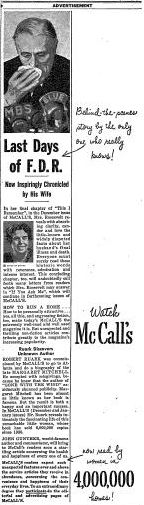
Here’s a detail of the top:
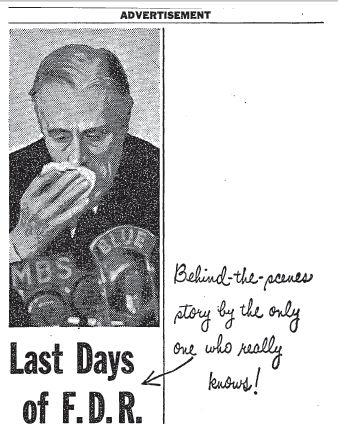
Here’s the first paragraph of the ad:

In her final chapter of “This I Remember,” in the December issue of McCALL’S, Mrs. Roosevelt reveals with absorbing clarity, candor and love the little-known and widely disputed facts about her husband’s final illness and death. Everyone must surely read these historic words with reverence, admiration and intense interest.

Here’s a description of the magazine more generally (ellipses in the original):

HOW TO RUN A HOME . . . How to be personally attractive . . . yes, all this, and engrossing fiction, too, make today’s McCALL’S the extremely well-read and well used magazine it is.

The last bit of faux-handwritten marginalia is McCall’s slogan from this period: “Now read by women in 4,000,000 homes!”
Mark Twain’s Many Mansions

[New York Press]

In this week’s New York Press, I’ve got a story about Mark Twain’s long-forgotten residence in Greenwich Village—and the 1954 crusade to save it. I first discovered this while doing some research (on one of these) for grad school stuff, and I quickly became obsessed with it. As you’ll see in my Press story, though, things got really interesting when I tracked down one of the story’s main players—a British film director who happens to be celebrating his 99th birthday this week. (This week also happens to be the centenary of Twain’s death; they just missed each other.)

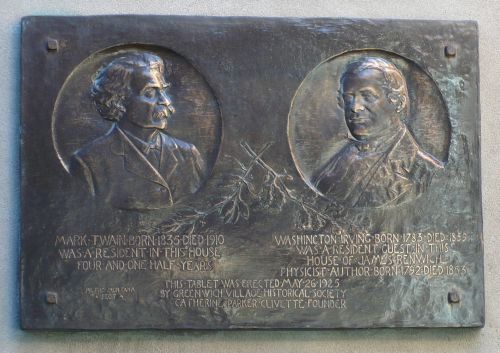
Anyway, the story’s obviously a New York-centric one, so, in deference to all the non-New Yorkers out there, I thought I’d share some photos I took while reporting this. Up top is the plaque—still there at the corner of Fifth and Ninth in Manhattan—that the Greenwich Village Historical Society set up in 1925. (Clara, Twain’s daughter who put up the “NO BILLIARDS AFTER 10 P.M.” sign, was at the ceremony.)

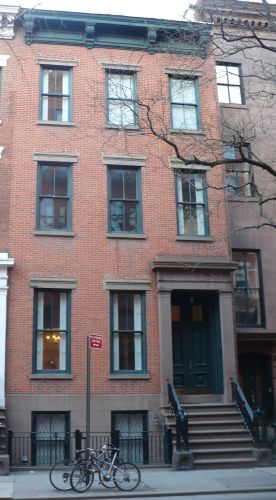
Here’s another 1840s townhouse a few blocks over from the site of the Twain House. (The Twain House, thanks to its architect, included more flourishes than this house: stained glass windows, Romanized details, and a whole lot of wrought iron.)

Here’s the faux-historical sign the developers slapped on the “tall ultramodern apartment building.”

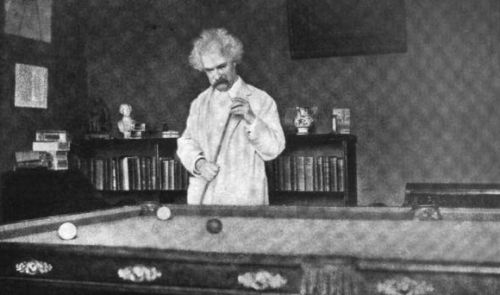
And here’s Twain at 21 Fifth Avenue, chalking his cue. There are a ton of great photos like this in Paine’s three-volume biography, which is available on Google Books. Here’s the third volume, in which, at several points, Paine signals that Twain was a bit of a cheater.